Case studies · Education · A doctoral researcher in educational technology
Do AI tutors teach, or just [answer]?
A doctoral researcher in educational technology has run a small pilot: a chatbot that gives hints instead of solutions, in a first-year statistics course. Meta-analyses say generative AI raises learning; some trials say it makes students worse once it’s taken away. They need to know where their study fits, and what it could show that nobody has shown yet.
Illustrative case: an anonymous researcher role, built in the real app. Every paper is a real Consensus record; readings are AI-written from abstracts.
The question
One sentence, and a pilot study
The researcher’s argument is that generative AI tutors help students learn only when they are designed to make students think, not to hand them answers. That sentence is the seed. Their two working papers go on the map as anchors, so every paper is read against what they have already found.
“Generative AI tutors improve learning only when they are designed to make students think, not to hand them answers.”
Home field: Learning sciences · Educational technology
The map
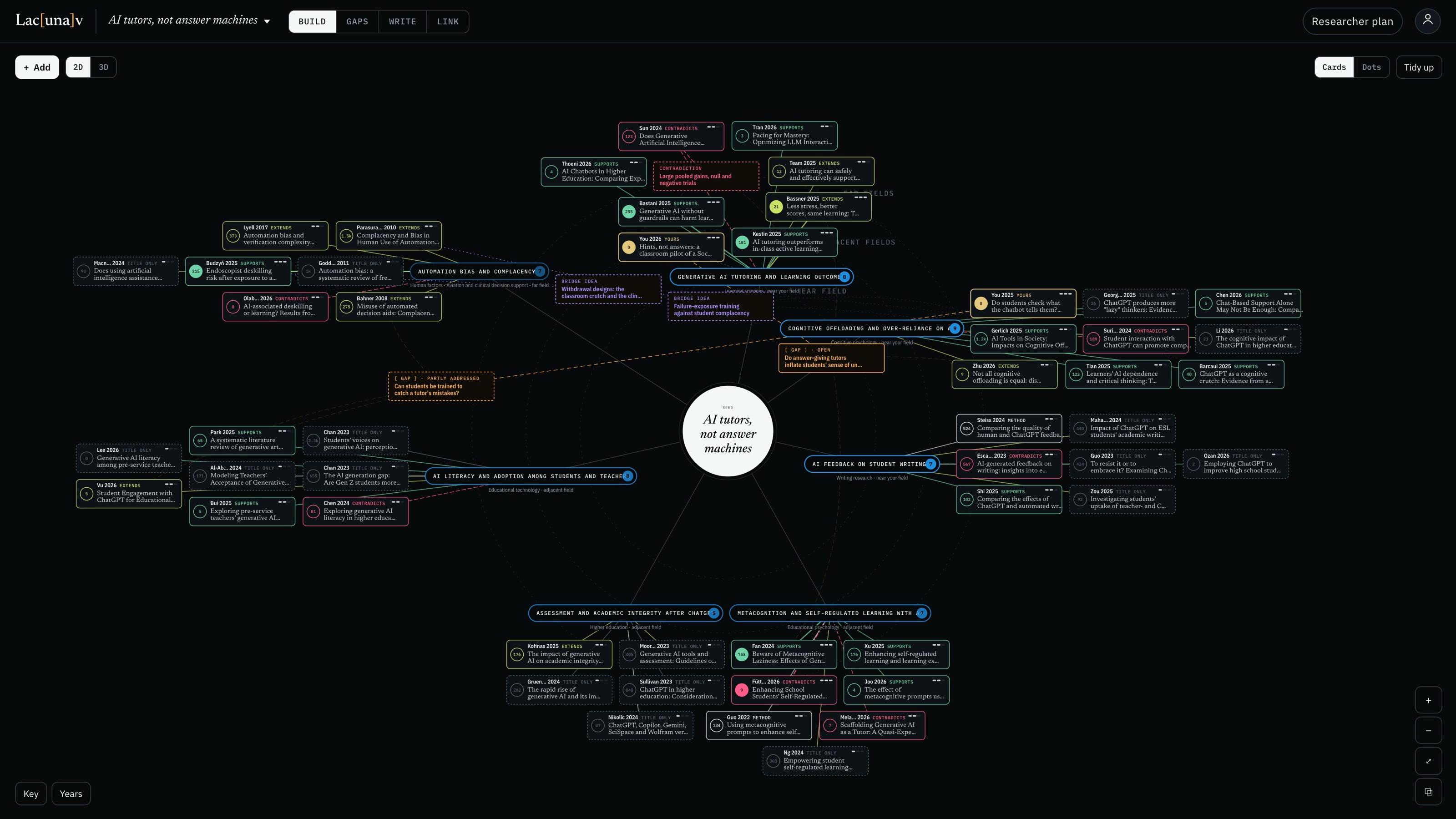
7 areas, from the home field to the far edge
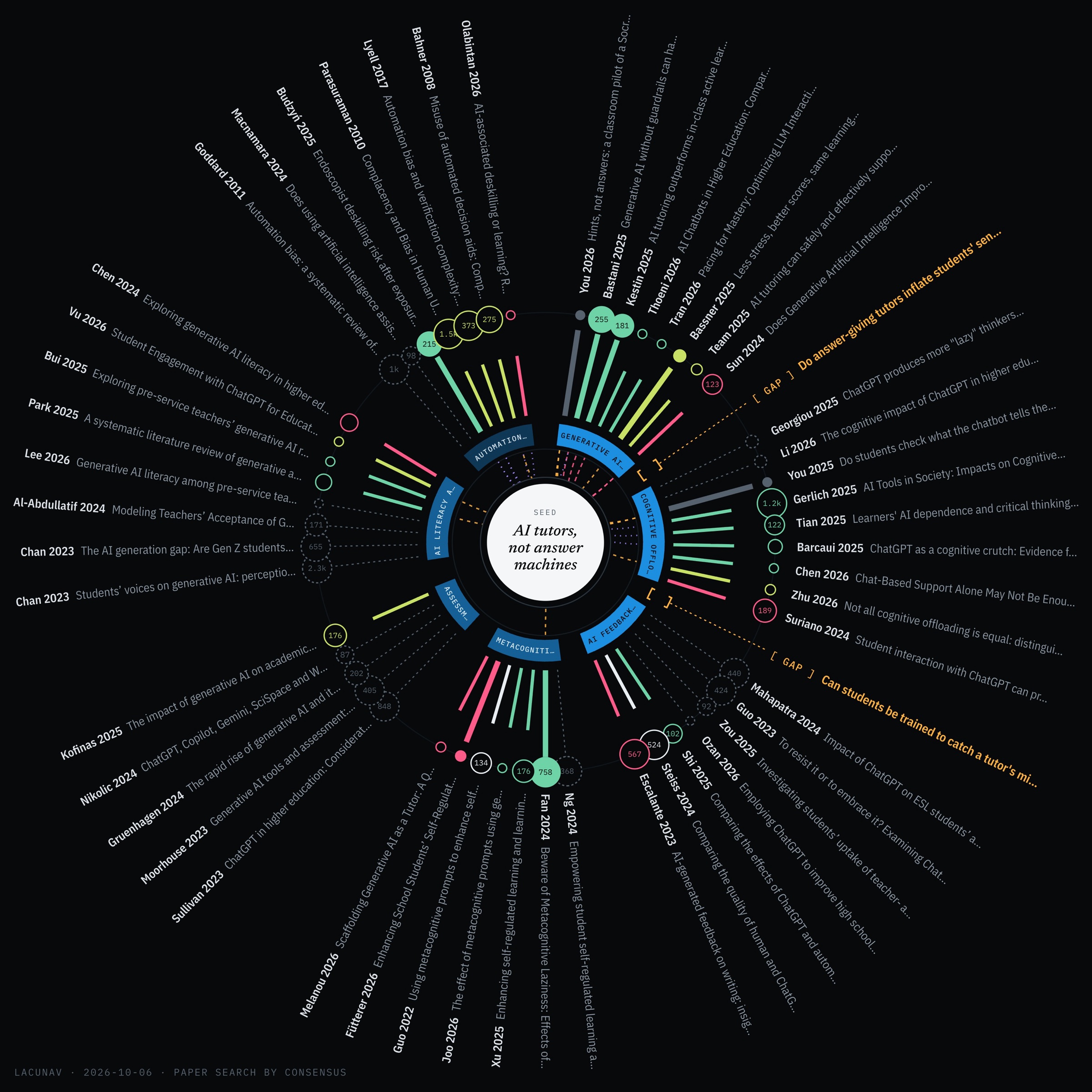
The near ring is the researcher’s home ground: AI-tutoring trials, cognitive offloading and AI feedback on writing. The adjacent ring brings in metacognition, assessment and AI literacy. The far ring is automation bias: decades of research on pilots and clinicians who trust the machine too much. It is where both bridges come from.
| Area | Ring | Papers | Why it’s on the map |
|---|---|---|---|
| Generative AI tutoring and learning outcomes | near | 8 | The core of your thesis: when an AI tutor raises measured learning, and when it only raises performance while the tool is there. |
| Cognitive offloading and over-reliance on AI | near | 9 | The mechanism your thesis names: what students stop doing in their heads when a chatbot will do it for them. |
| AI feedback on student writing | near | 7 | The largest applied testbed for AI help; it shows whether better drafts mean better writers. |
| Metacognition and self-regulated learning with AI | adjacent | 7 | Your hint-first design is a metacognitive intervention; this literature says which prompts make students monitor their own thinking. |
| Assessment and academic integrity after ChatGPT | adjacent | 5 | If output no longer shows understanding, your outcome measures must be unaided; this is where that problem is debated. |
| AI literacy and adoption among students and teachers | adjacent | 8 | Whether students will accept a tutor that withholds answers, and whether they can judge the answers they get, depends on literacy and attitudes. |
| Automation bias and complacency | far | 7 | Forty years of evidence on what happens to human skill and vigilance when a reliable aid does the work: the field your thesis rediscovers. |
Your work as anchor
Every reading, written against your own study
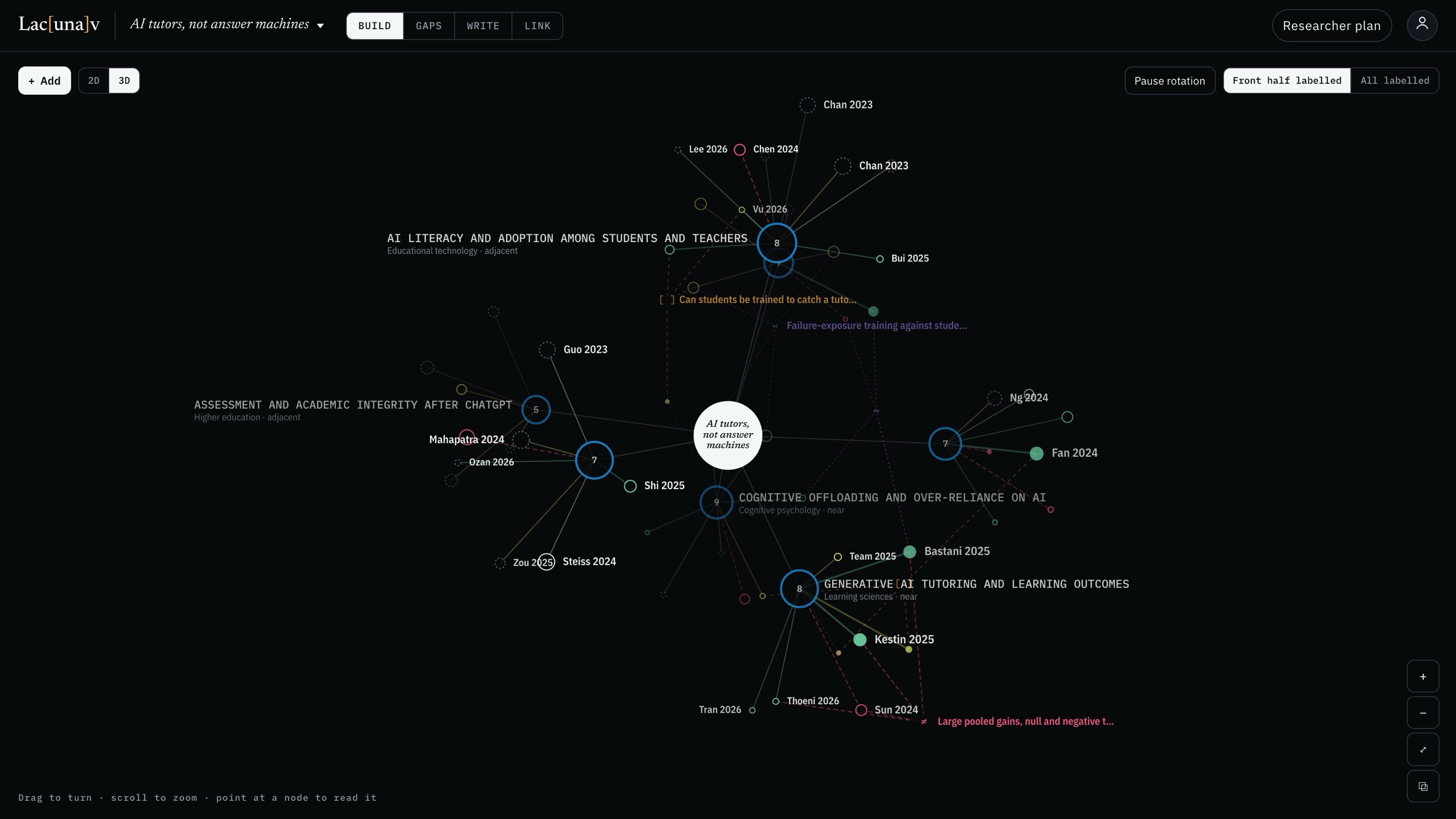
The researcher added two of their own working papers by hand: a classroom pilot of a hint-giving tutor, and a think-aloud study of whether students check chatbot answers. They sit on the map in gold. From then on, every skim, deep read, gap and review is written against them, which is why the open gap below ends with “your statistics pilot already collects…”.
- p1Hints, not answers: a classroom pilot of a Socratic AI tutor in first-year statistics · working paper, 2026
- p2Do students check what the chatbot tells them? A think-aloud study of verification · working paper, 2025
Claims × areas
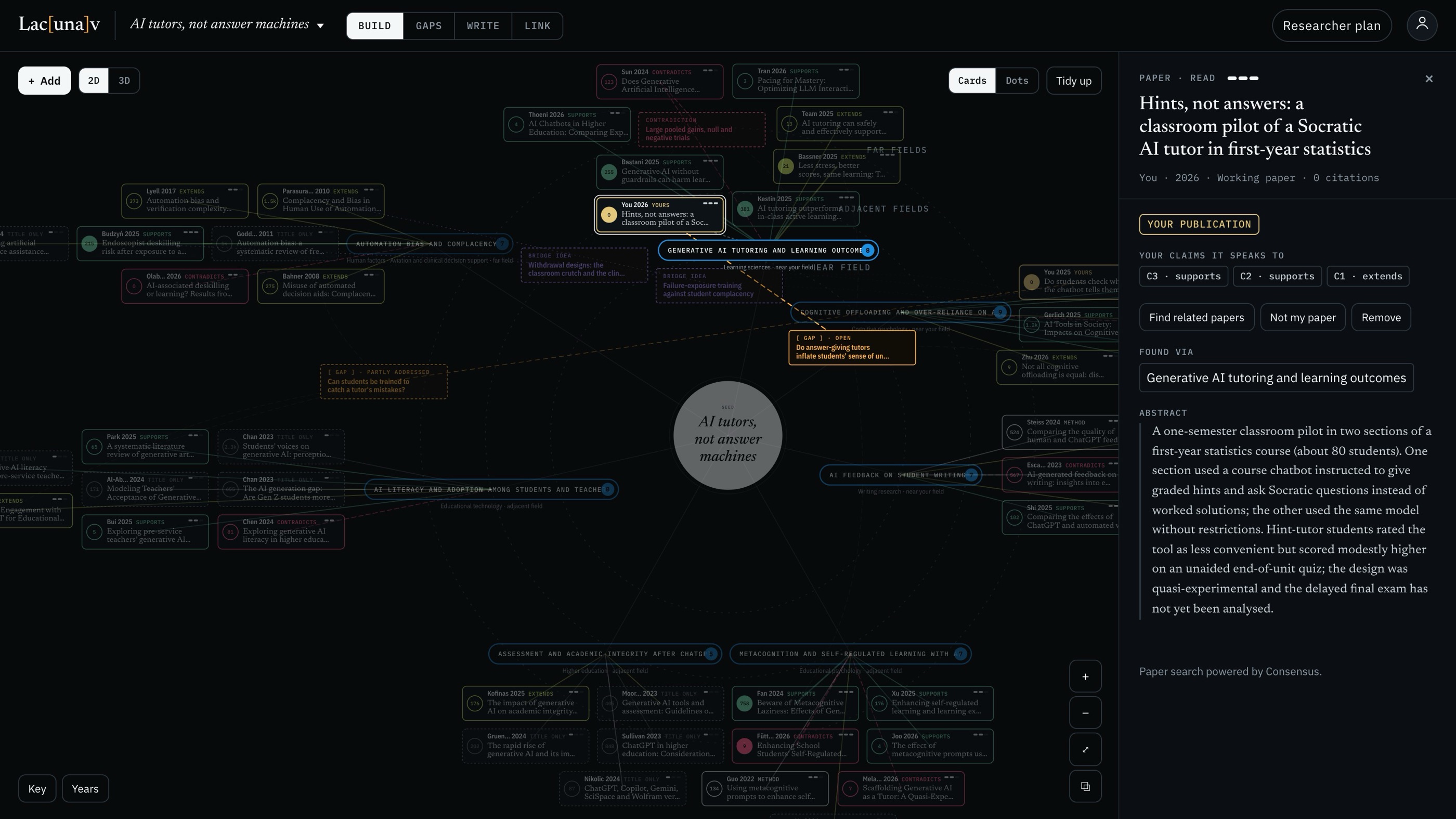
Where the thesis has evidence, and where it has none
- C1Generative AI tutors raise measured learning outcomes
- C2Answer-giving AI harms later unaided performance
- C3Hint-first, Socratic tutor design protects learning
- C4Students offload thinking and over-rely on AI
- C5Metacognitive prompts restore self-regulation
- C6Students verify AI output when equipped to
The open gap
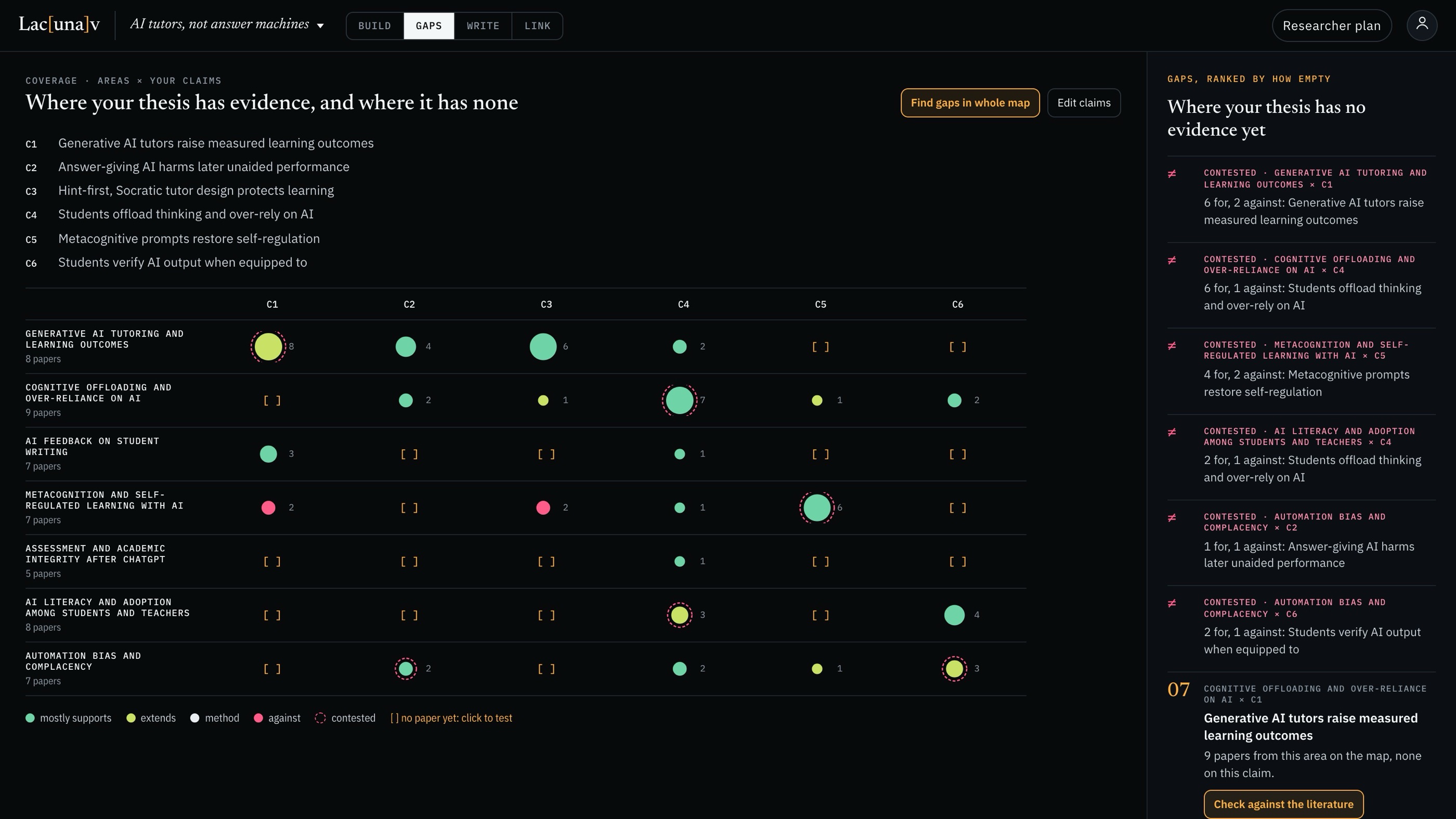
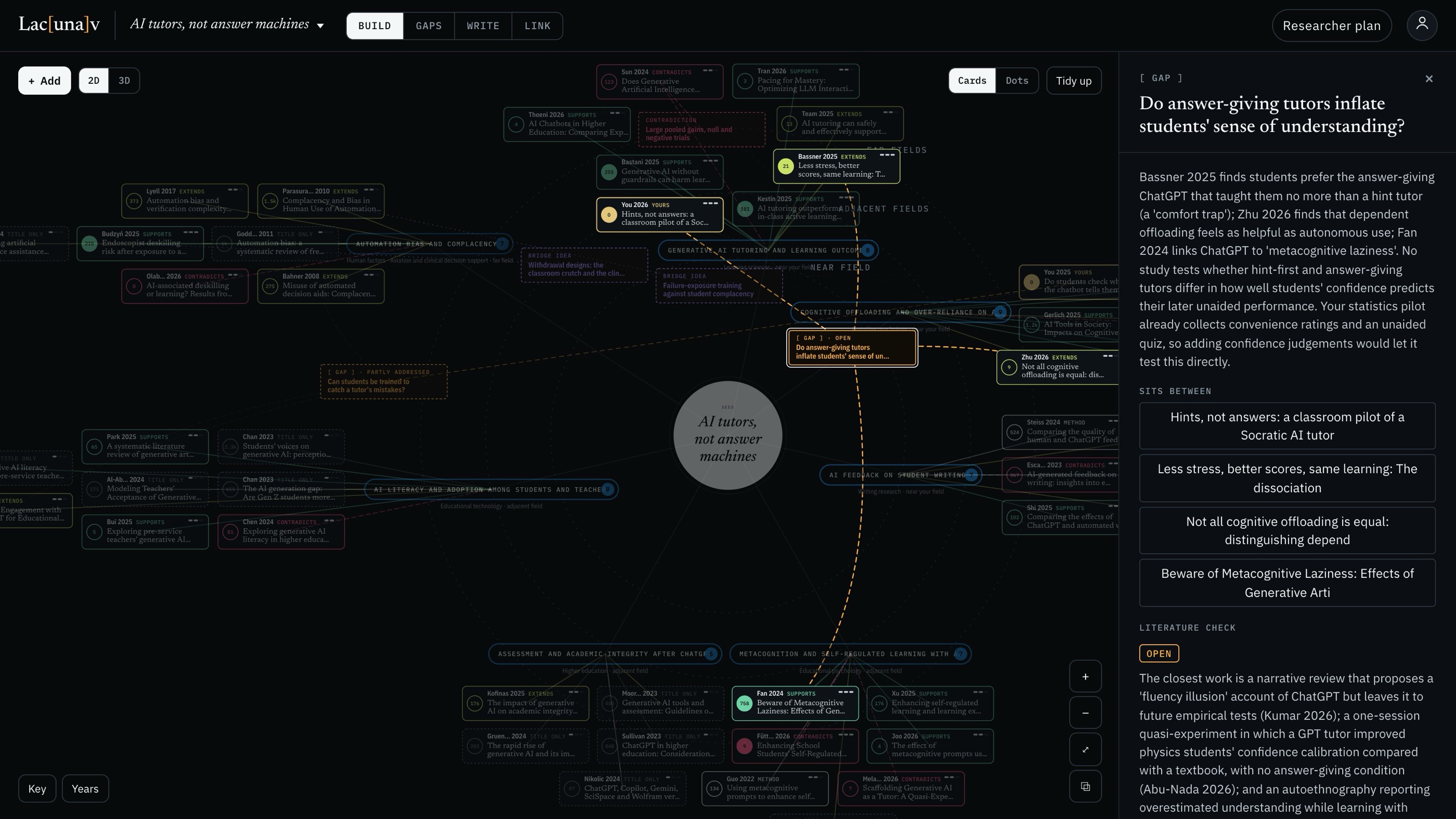
Do answer-giving tutors inflate students' sense of understanding?
Bassner 2025 finds students prefer the answer-giving ChatGPT that taught them no more than a hint tutor (a 'comfort trap'); Zhu 2026 finds that dependent offloading feels as helpful as autonomous use; Fan 2024 links ChatGPT to 'metacognitive laziness'. No study tests whether hint-first and answer-giving tutors differ in how well students' confidence predicts their later unaided performance. Your statistics pilot already collects convenience ratings and an unaided quiz, so adding confidence judgements would let it test this directly.
The closest work is a narrative review that proposes a 'fluency illusion' account of ChatGPT but leaves it to future empirical tests (Kumar 2026); a one-session quasi-experiment in which a GPT tutor improved physics students' confidence calibration compared with a textbook, with no answer-giving condition (Abu-Nada 2026); and an autoethnography reporting overestimated understanding while learning with ChatGPT (Stojanov 2023). None compares tutor designs on calibration against later unaided performance.
Test query: students judgments of learning overconfidence illusion of competence after AI tutor or ChatGPT help
A contradiction
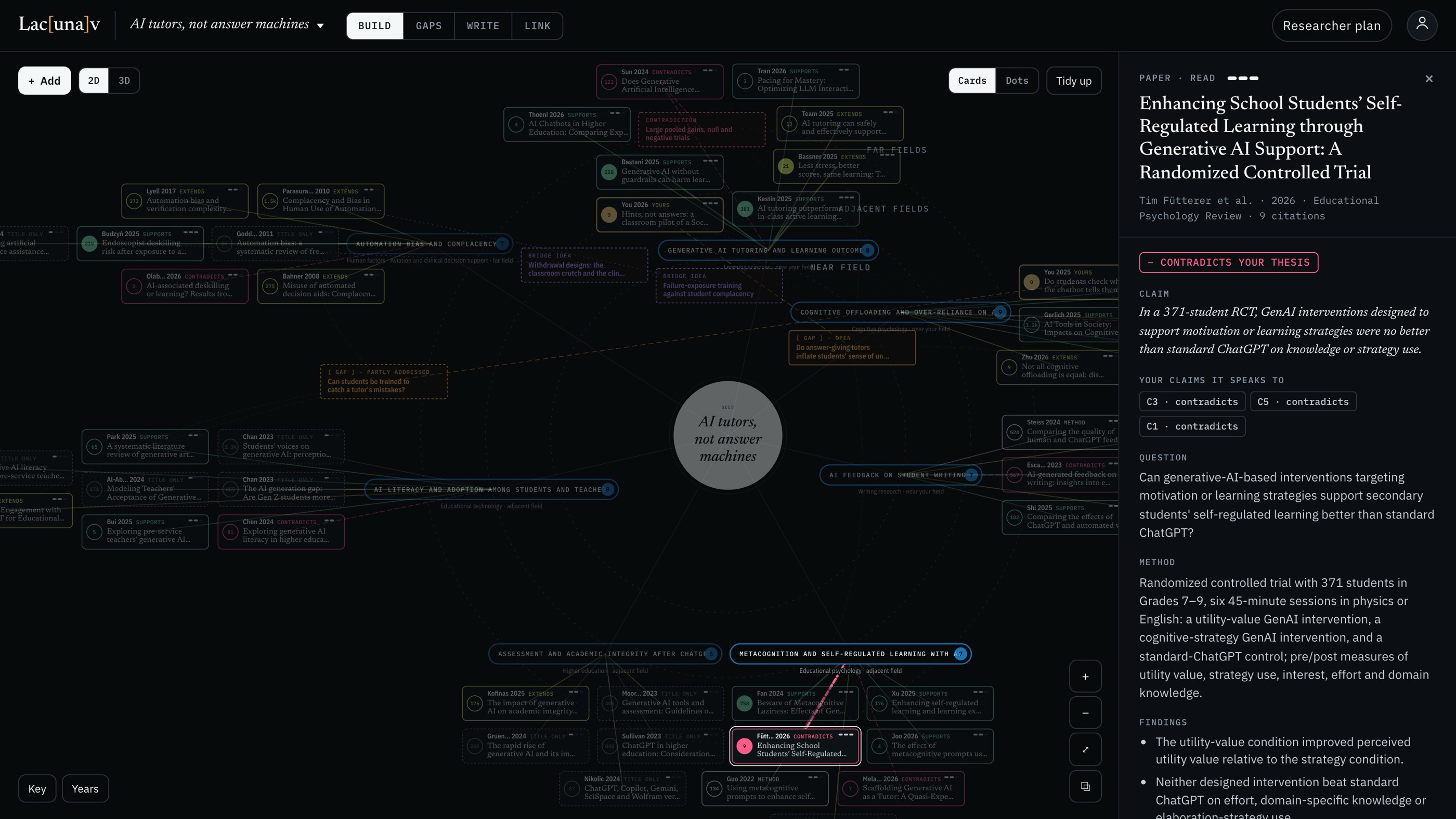
Large pooled gains, null and negative trials
Meta-analyses report medium effects of generative AI on achievement (Sun 2024, g = 0.53), and a carefully designed tutor beat in-class active learning (Kestin 2025). Yet a semester-long RAG chatbot RCT found no effect on any outcome (Thoeni 2026), and unrestricted GPT-4 left students 17% worse once it was taken away (Bastani 2025). When the outcome is measured (with or without AI, immediately or after a delay) may explain much of the split.
Everything it found
5 directions for the next paper
Each finding is tied to the papers it comes from and has a query you can run again.
Do answer-giving tutors inflate students' sense of understanding?
Bassner 2025 finds students prefer the answer-giving ChatGPT that taught them no more than a hint tutor (a 'comfort trap'); Zhu 2026 finds that dependent offloading feels as helpful as autonomous use; Fan 2024 links ChatGPT to 'metacognitive laziness'. No study tests whether hint-first and answer-giving tutors differ in how well students' confidence predicts their later unaided performance. Your statistics pilot already collects convenience ratings and an unaided quiz, so adding confidence judgements would let it test this directly.
Between: your working paper, Bassner et al. 2025, Zhu et al. 2026, Fan et al. 2024
Can students be trained to catch a tutor's mistakes?
Most surveyed students say they are critical of AI output (Chen 2024), yet reviews and surveys find critical evaluation is their weakest skill (Park 2025, Bui 2025), and your think-aloud study saw fewer than half of the answers students used checked. Human-factors research shows that experiencing rare automation failures during training reduces complacency (Bahner 2008), and inoculation messages can raise verification (Vu 2026), but AI tutors in courses are evaluated only with correct output.
Between: your working paper, Park 2025, Bahner et al. 2008, Vu et al. 2026
Large pooled gains, null and negative trials
Meta-analyses report medium effects of generative AI on achievement (Sun 2024, g = 0.53), and a carefully designed tutor beat in-class active learning (Kestin 2025). Yet a semester-long RAG chatbot RCT found no effect on any outcome (Thoeni 2026), and unrestricted GPT-4 left students 17% worse once it was taken away (Bastani 2025). When the outcome is measured (with or without AI, immediately or after a delay) may explain much of the split.
Between: Sun et al. 2024, Kestin et al. 2025, Thoeni et al. 2026, Bastani et al. 2025
Withdrawal designs: the classroom crutch and the clinic's deskilling
Endoscopists' unaided adenoma detection fell after AI was introduced (Budzyń 2025), though over a third improved durably in a UK cohort (Olabintan 2026). Bastani 2025 and Barcaui 2025 find the same 'worse without it' pattern in students. Clinical withdrawal designs, with phases measured before, during and after the aid, are a ready template for testing AI tutors over a term.
Between: Budzyń et al. 2025, Olabintan et al. 2026, Bastani et al. 2025, Barcaui 2025
Failure-exposure training against student complacency
Automation-bias research finds complacency in experts and novices alike, rooted in attention (Parasuraman 2010), and reduced when operators meet rare automation failures in training (Bahner 2008). Education studies document AI dependence and weaker critical thinking (Tian 2025, Gerlich 2025) but have not borrowed this remedy: a tutor that occasionally and openly errs could train students to check.
Between: Parasuraman et al. 2010, Bahner et al. 2008, Tian et al. 2025, Gerlich 2025
Write
A cited review and a figure, drafted from the map
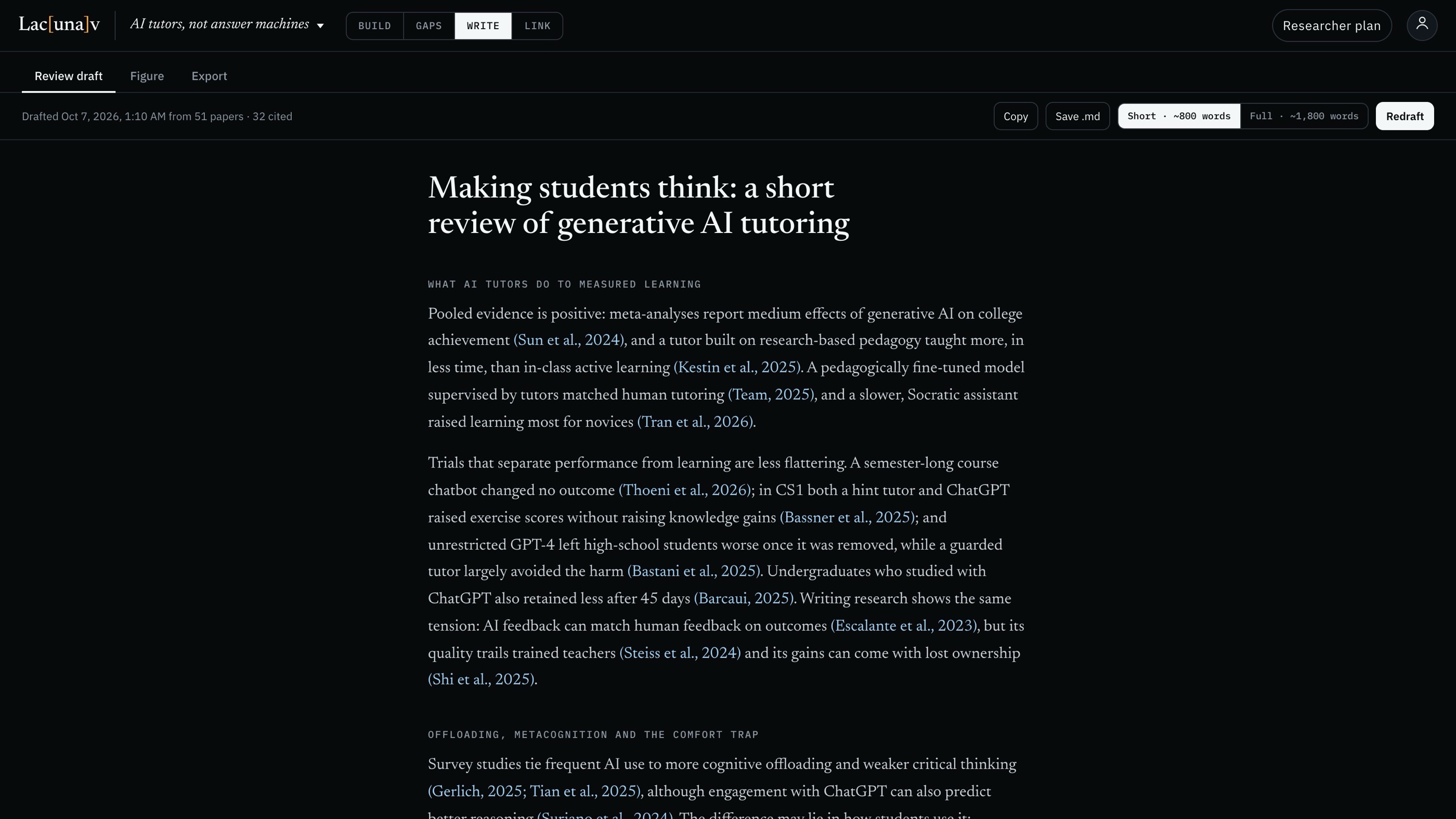
Making students think: a short review of generative AI tutoring: What AI tutors do to measured learning · Offloading, metacognition and the comfort trap · Lessons from automation research. Every citation is a paper on the map.
Link
Two maps: AI tutors, not answer machines × Desirable Difficulties and Retrieval Practice
Both maps are about effort: the AI-tutoring map asks what happens when a machine removes it, and the desirable-difficulties map shows why that effort produces durable learning. Answer-giving tutors turn retrieval into restudy and problem solving into reading, which predicts the delayed, unaided losses on the first map.
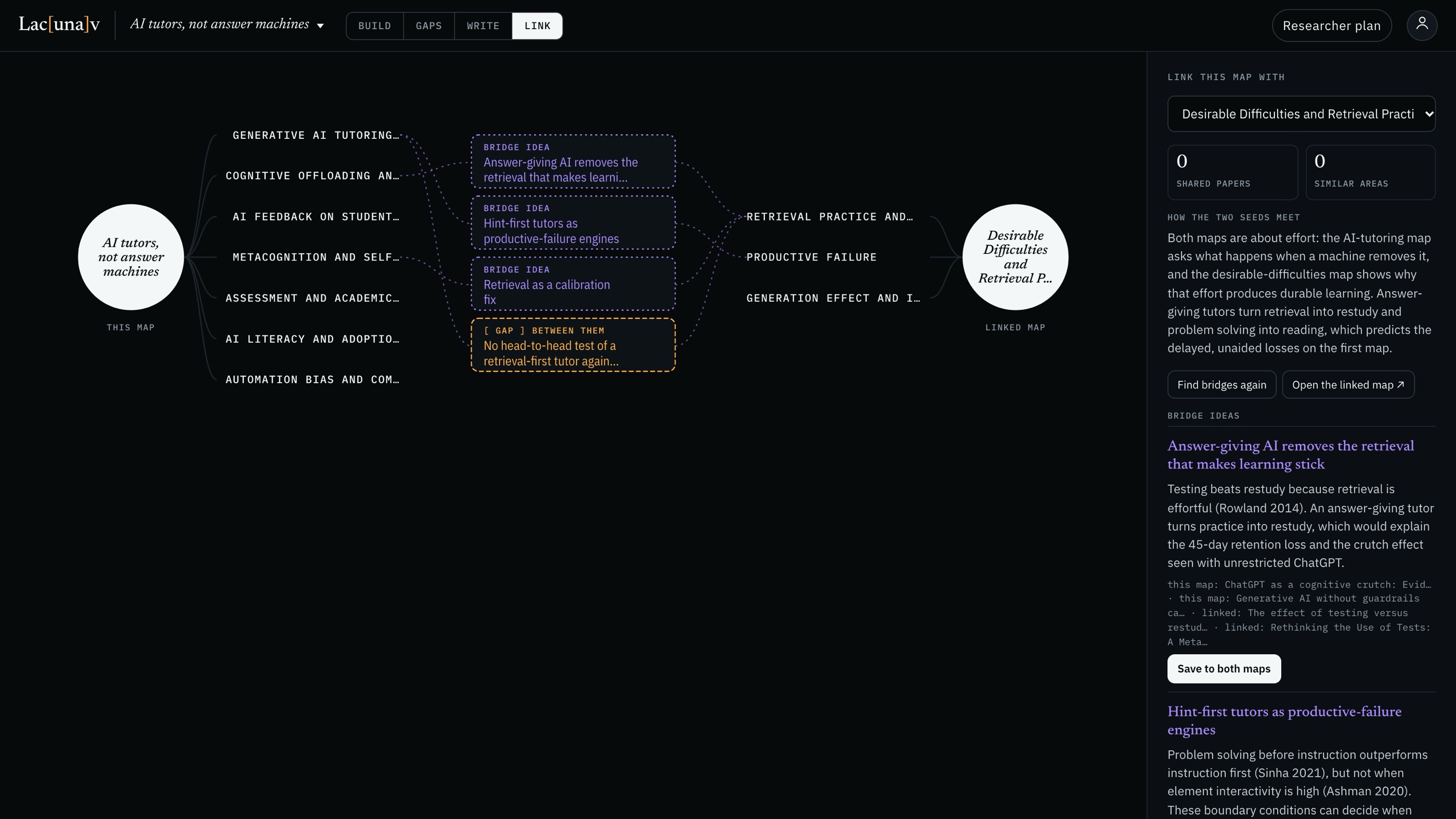
Answer-giving AI removes the retrieval that makes learning stick
Testing beats restudy because retrieval is effortful (Rowland 2014). An answer-giving tutor turns practice into restudy, which would explain the 45-day retention loss and the crutch effect seen with unrestricted ChatGPT.
Hint-first tutors as productive-failure engines
Problem solving before instruction outperforms instruction first (Sinha 2021), but not when element interactivity is high (Ashman 2020). These boundary conditions can decide when your tutor should withhold the answer and when it should explain.
Retrieval as a calibration fix
Retrieval practice made students' confidence judgements more accurate a week later (Barenberg 2018). Retrieval prompts inside an AI tutor could counter the metacognitive laziness and comfort trap seen with answer-giving AI.
No head-to-head test of a retrieval-first tutor against an answer-giving tutor
AI-assisted retrieval practice has been compared with no-AI cohorts, and designed tutors with active learning, but no study found pits a tutor that makes students retrieve or generate before it answers against an answer-giving tutor on the same delayed, unaided test.
Key papers
The sources behind the findings
A selection of the 49 real papers on the map: the ones read in depth and the ones each finding rests on.
- AI tutoring outperforms in-class active learning: an RCT introducing a novel research-based design in an authentic educational setting
Gregory Kestin et al. · 2025 · Scientific Reports · doi:10.1038/s41598-025-97652-6 - Generative AI without guardrails can harm learning: Evidence from high school mathematics
Hamsa Bastani et al. · 2025 · Proceedings of the National Academy of Sciences of the United States of America · doi:10.1073/pnas.2422633122 - Less stress, better scores, same learning: The dissociation of performance and learning in AI-supported programming education
Patrick Bassner et al. · 2025 · Comput. Educ. Artif. Intell. · doi:10.1016/j.caeai.2025.100537 - Beware of Metacognitive Laziness: Effects of Generative Artificial Intelligence on Learning Motivation, Processes, and Performance
Yizhou Fan et al. · 2024 · ArXiv · doi:10.1111/bjet.13544 - Enhancing School Students’ Self-Regulated Learning through Generative AI Support: A Randomized Controlled Trial
Tim Fütterer et al. · 2026 · Educational Psychology Review · doi:10.1007/s10648-026-10133-8 - Endoscopist deskilling risk after exposure to artificial intelligence in colonoscopy: a multicentre, observational study.
K. Budzyń et al. · 2025 · The lancet. Gastroenterology & hepatology · doi:10.1016/s2468-1253(25)00133-5 - Not all cognitive offloading is equal: distinguishing dependent and autonomous offloading to generative AI
Qiu-Han Zhu et al. · 2026 · Frontiers in Psychology · doi:10.3389/fpsyg.2026.1878629 - A systematic literature review of generative artificial intelligence (GenAI) literacy in schools
Joonhyeong Park · 2025 · Comput. Educ. Artif. Intell. · doi:10.1016/j.caeai.2025.100487 - Misuse of automated decision aids: Complacency, automation bias and the impact of training experience
J. Bahner et al. · 2008 · Int. J. Hum. Comput. Stud. · doi:10.1016/j.ijhcs.2008.06.001 - Student Engagement with ChatGPT for Educational Tasks: Effects of Inoculation Training on Verification Intentions and Behavior
C. Vu et al. · 2026 · Computers and Education Open · doi:10.1016/j.caeo.2026.100335 - Does Generative Artificial Intelligence Improve the Academic Achievement of College Students? A Meta-Analysis
Lihui Sun et al. · 2024 · Journal of Educational Computing Research · doi:10.1177/07356331241277937 - AI Chatbots in Higher Education: Comparing Expectations to Evidence
Andrew Thoeni et al. · 2026 · Computers in Human Behavior Reports · doi:10.1016/j.chbr.2026.101061 - AI-associated deskilling or learning? Results from 114 colonoscopists in NAIAD, a UK nationwide real-world study of CADe in colonoscopy
O. Olabintan et al. · 2026 · Endoscopy · doi:10.1055/s-0046-1822929 - ChatGPT as a cognitive crutch: Evidence from a randomized controlled trial on knowledge retention
A. Barcaui · 2025 · Social Sciences & Humanities Open · doi:10.1016/j.ssaho.2025.102287
What to trust, and what to check
Strong leads, not verdicts
Real sources
Every paper is a real Consensus record with its link and DOI. Nothing was invented to fill a gap.
AI reading, your judgement
Skims and deep reads use abstracts, not full texts. “Open” means the check found no close study: a lead to verify.
How this case was made
The map was built from fifteen Consensus searches. The researcher is an illustrative role; their two gold working papers are hand-added illustrations, not real publications. Every other paper is real.
Your turn
What’s [missing] in your field?
Write one sentence about your argument and let the map grow from there.