Case studies · Public health · A team designing a school programme
Does worry fuel action, or [stall it]?
A public-health team is about to design a school programme on climate anxiety. Before they write a protocol, they need to know three things: what the literature agrees on, where it contradicts itself, and which study nobody has run yet.
Illustrative case: an anonymous researcher role, built in the real app. Every paper is a real Consensus record; readings are AI-written from abstracts.
The question
One sentence to start
The team’s working assumption is that climate anxiety is a rational response that can be channelled into action, but harms young people when they are left alone with it. That sentence is the seed. Lacunav reads every paper against it.
“Climate anxiety in young people is a rational response that can motivate action, but without collective support it harms their mental health.”
Home field: Public health · Environmental psychology
The map
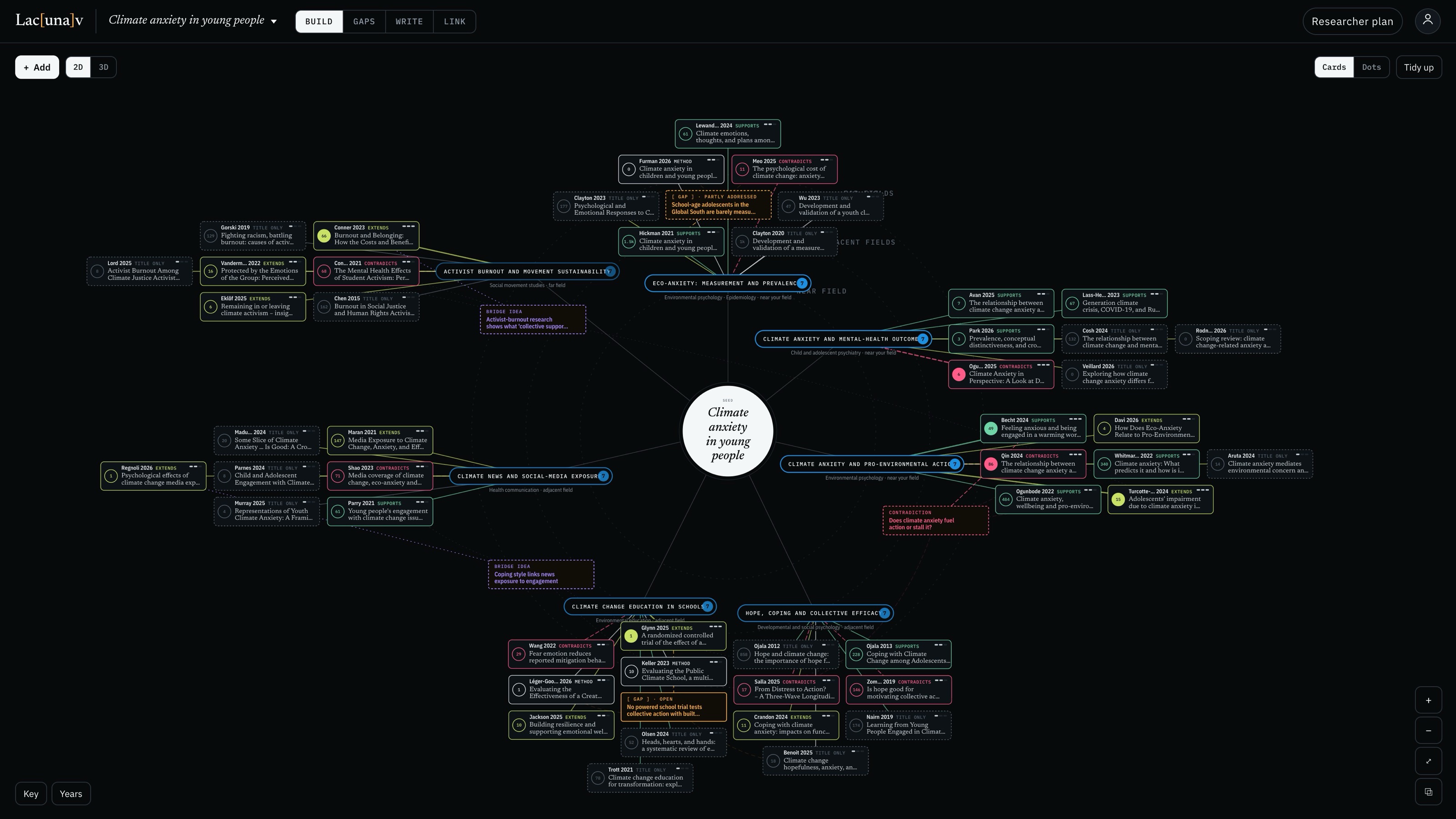
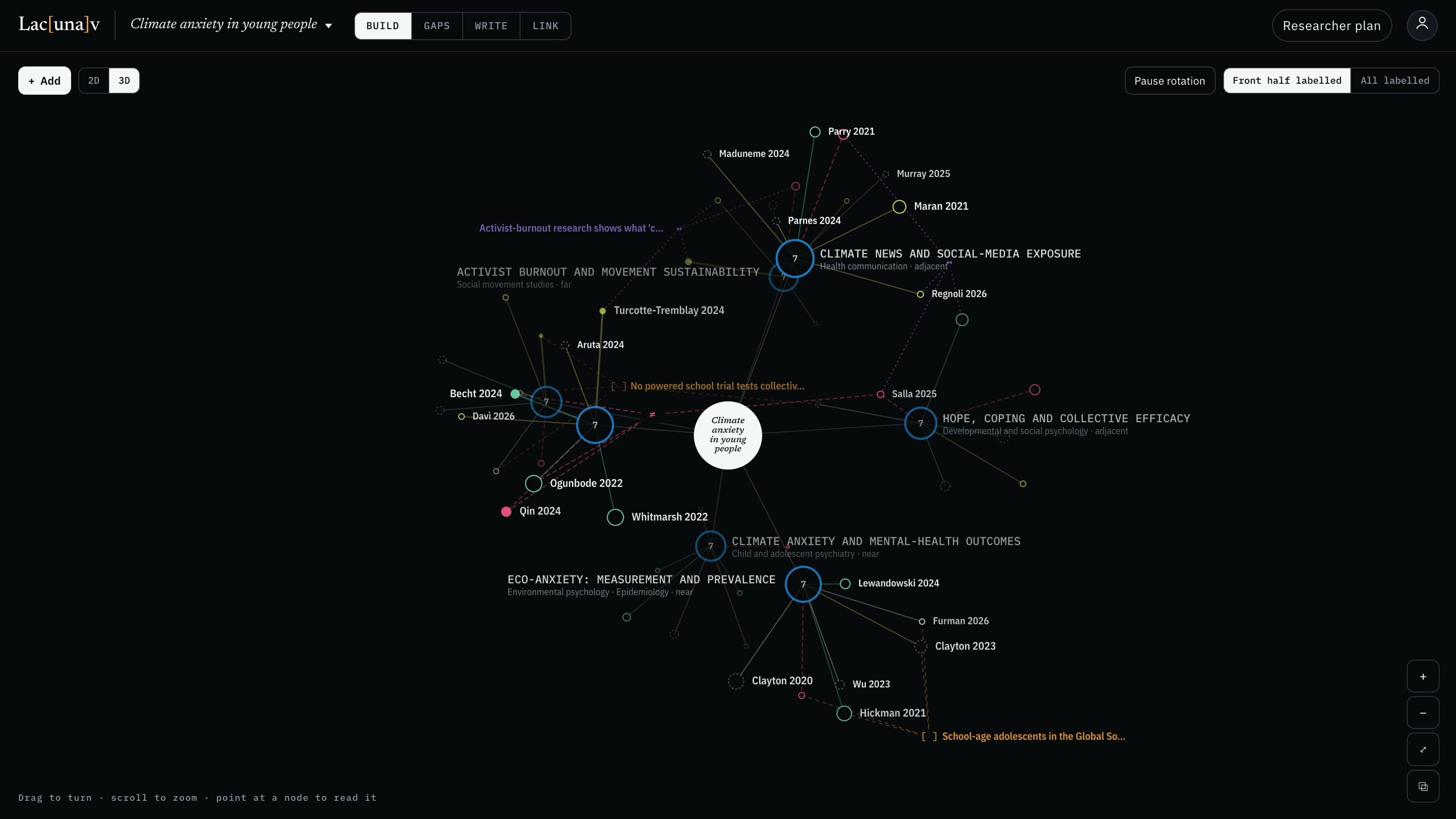
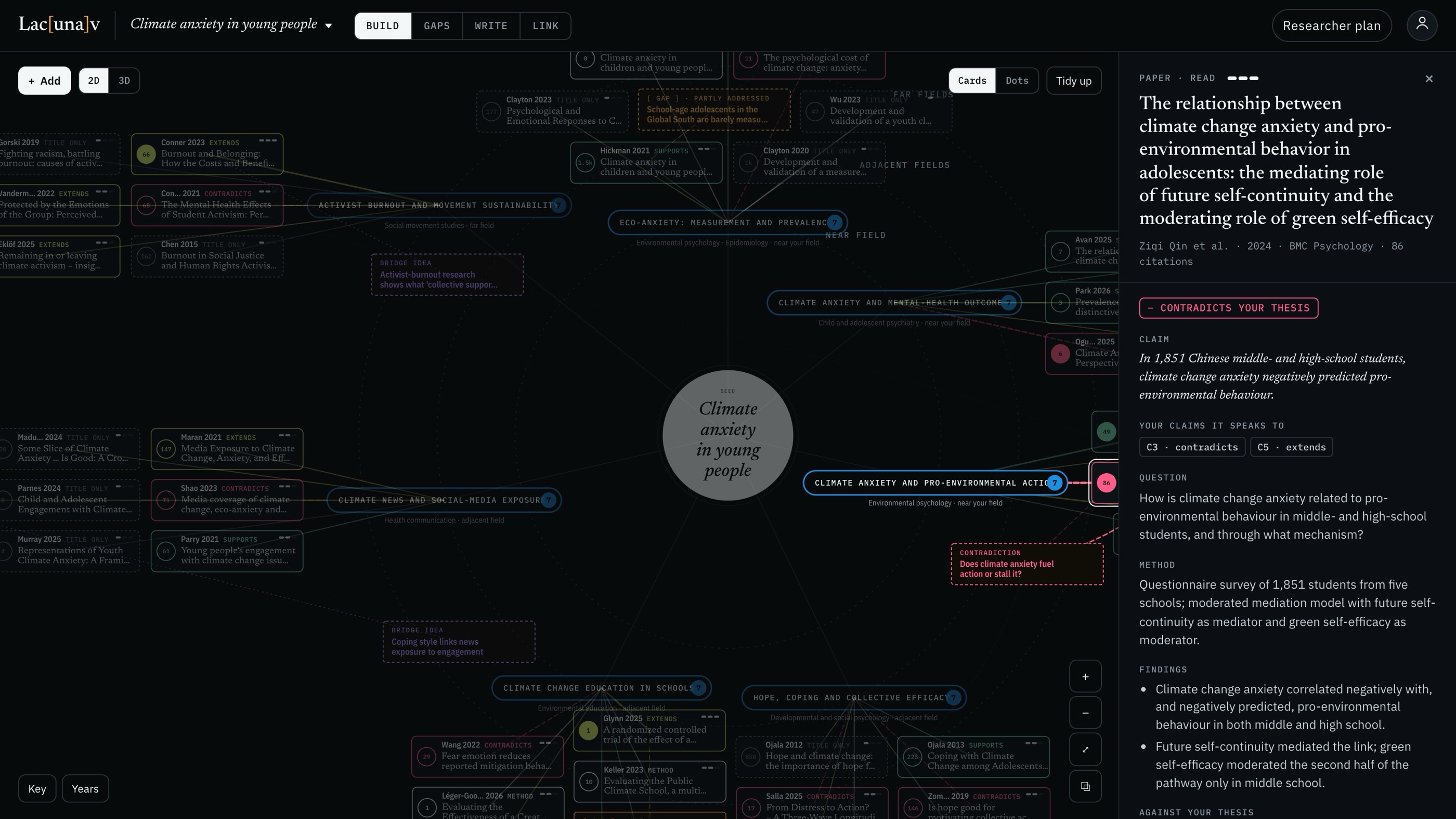
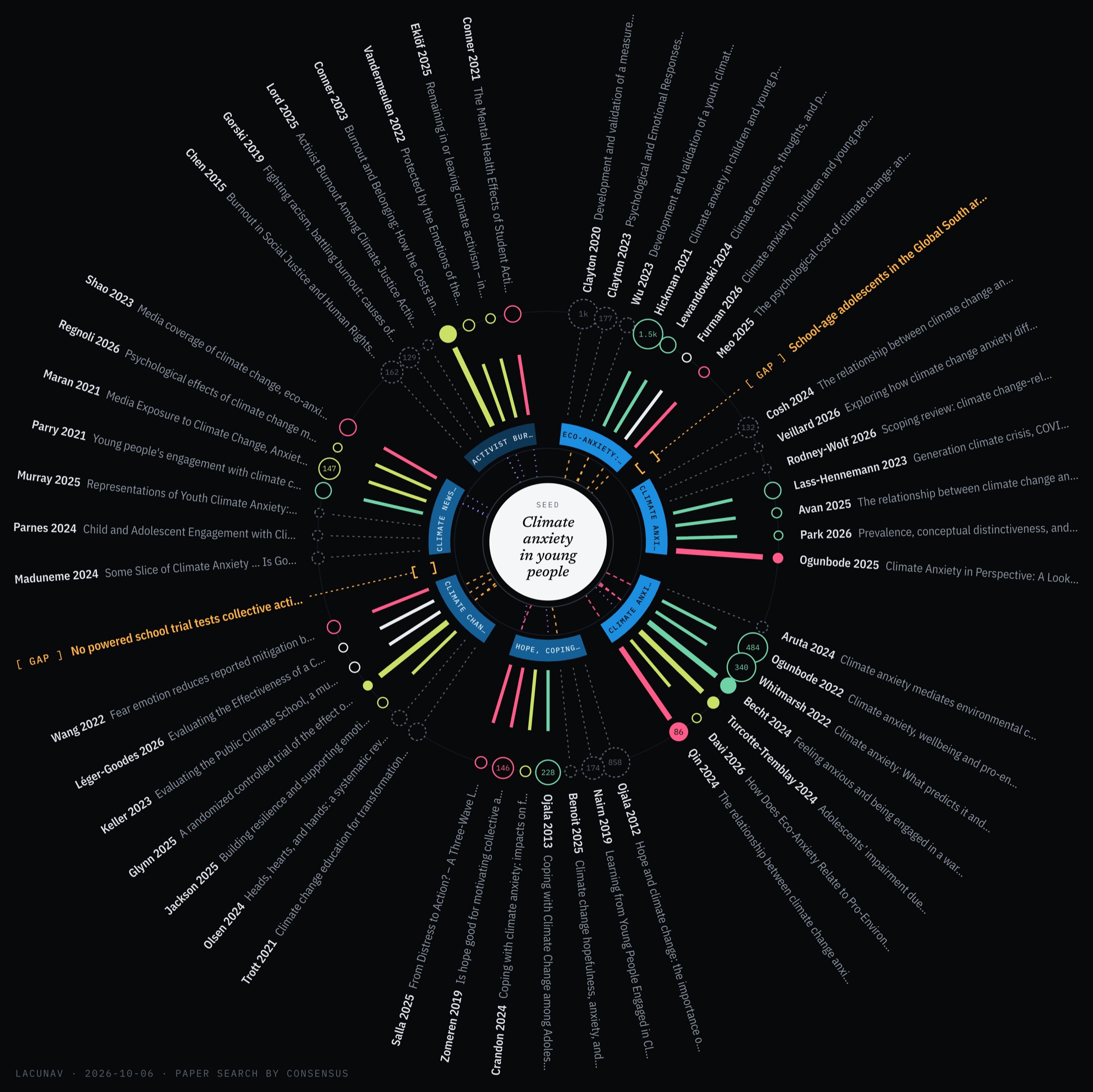
7 areas, from the home field to the far edge
The near ring holds the team’s own field: measurement, mental-health outcomes and the link to action. The adjacent ring brings in coping, schools and news exposure. The far ring is research on activist burnout, a literature climate psychologists rarely cite, and the source of the strongest bridge.
| Area | Ring | Papers | Why it’s on the map |
|---|---|---|---|
| Eco-anxiety: measurement and prevalence | near | 7 | Tells your team how many pupils to expect to be affected, and warns that the number depends heavily on how you measure it. |
| Climate anxiety and mental-health outcomes | near | 7 | The harm half of your thesis: whether climate anxiety goes with depression, poor sleep and impaired functioning in school-age young people. |
| Climate anxiety and pro-environmental action | near | 7 | The motivation half of your thesis: does anxiety push pupils towards action, or freeze them? |
| Hope, coping and collective efficacy | adjacent | 7 | The 'collective support' half of your thesis: which coping styles and kinds of hope turn worry into wellbeing and action. |
| Climate change education in schools | adjacent | 7 | Where your programme will live: what school-based climate teaching does to pupils' emotions and actions. |
| Climate news and social-media exposure | adjacent | 7 | Most pupils meet climate change through feeds and news, not lessons; this shapes the anxiety your programme starts from. |
| Activist burnout and movement sustainability | far | 7 | A surprising source: decades of work on why activists burn out shows what 'collective support' has to contain for action to protect rather than exhaust. |
Claims × areas
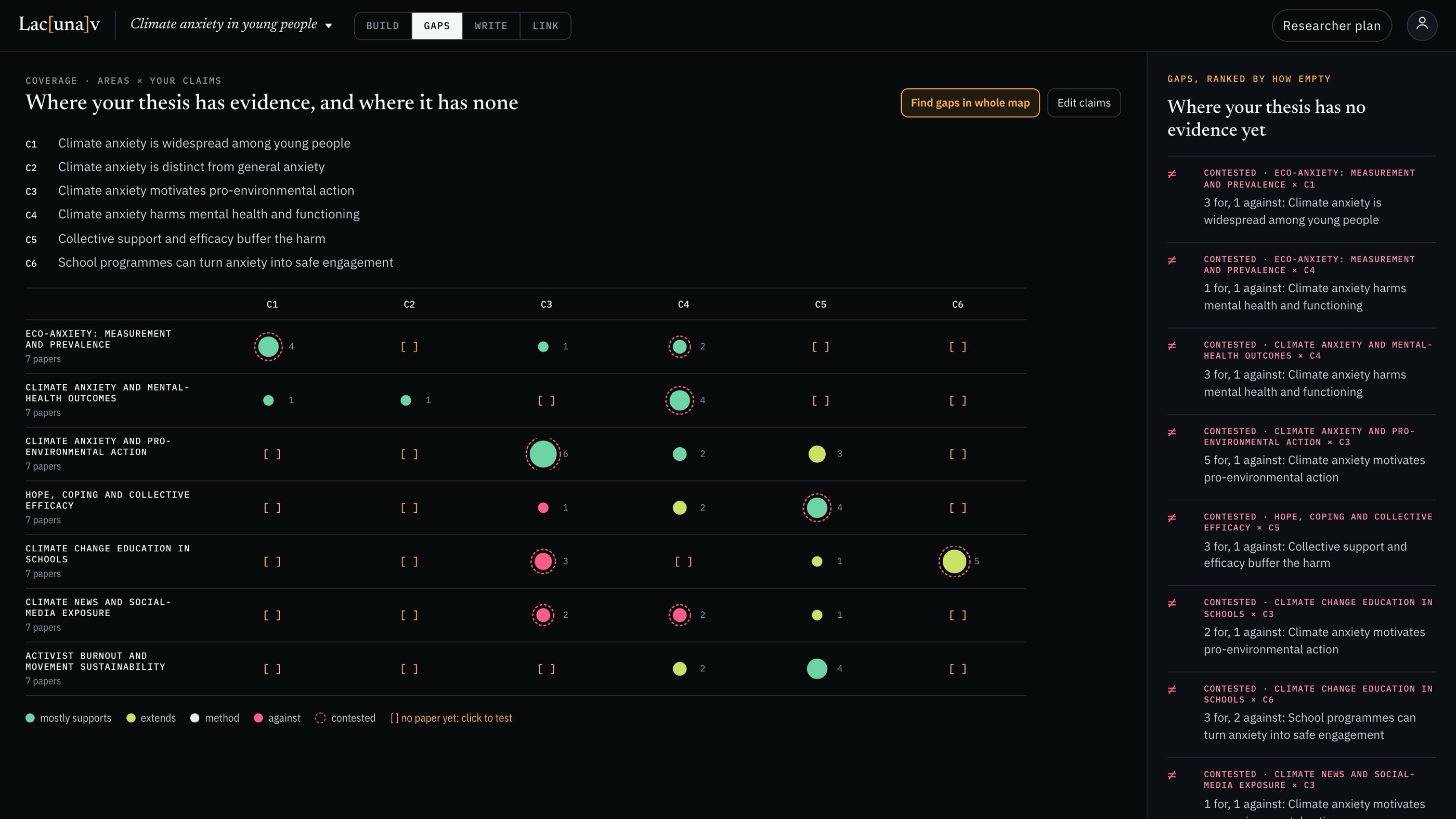
Where the thesis has evidence, and where it has none
- C1Climate anxiety is widespread among young people
- C2Climate anxiety is distinct from general anxiety
- C3Climate anxiety motivates pro-environmental action
- C4Climate anxiety harms mental health and functioning
- C5Collective support and efficacy buffer the harm
- C6School programmes can turn anxiety into safe engagement
The open gap
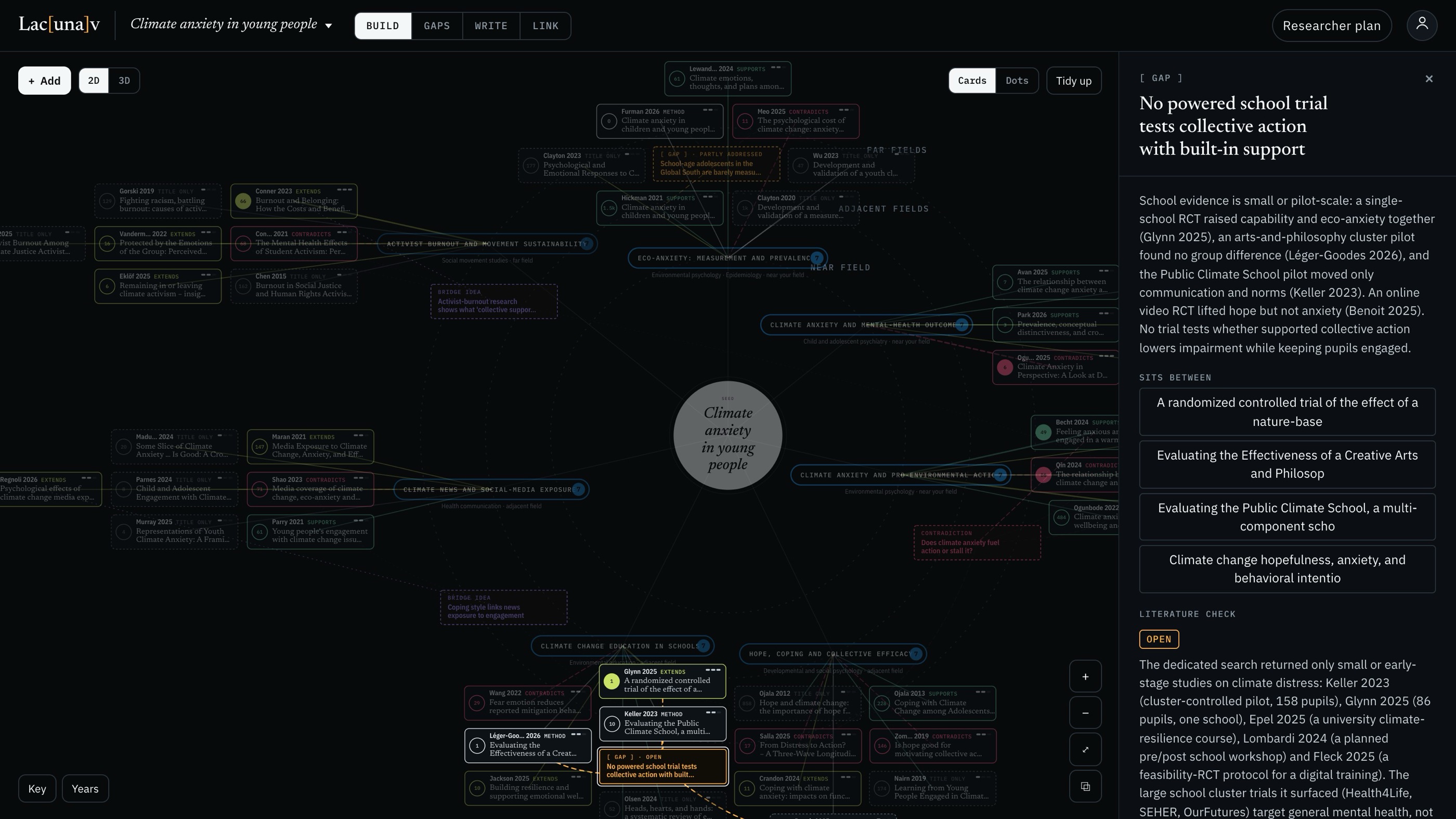
No powered school trial tests collective action with built-in support
School evidence is small or pilot-scale: a single-school RCT raised capability and eco-anxiety together (Glynn 2025), an arts-and-philosophy cluster pilot found no group difference (Léger-Goodes 2026), and the Public Climate School pilot moved only communication and norms (Keller 2023). An online video RCT lifted hope but not anxiety (Benoit 2025). No trial tests whether supported collective action lowers impairment while keeping pupils engaged.
The dedicated search returned only small or early-stage studies on climate distress: Keller 2023 (cluster-controlled pilot, 158 pupils), Glynn 2025 (86 pupils, one school), Epel 2025 (a university climate-resilience course), Lombardi 2024 (a planned pre/post school workshop) and Fleck 2025 (a feasibility-RCT protocol for a digital training). The large school cluster trials it surfaced (Health4Life, SEHER, OurFutures) target general mental health, not climate anxiety. No adequately powered school cluster-randomised trial of a collective-action climate programme with mental-health outcomes was found.
Test query: randomized controlled trial school programme reduces climate anxiety adolescents collective action mental health outcomes
A contradiction
Does climate anxiety fuel action or stall it?
Becht 2024 (N = 2,211) and Ogunbode 2022 (32 countries) find a positive link between climate anxiety and pro-environmental behaviour. Qin 2024 finds a negative link in 1,851 Chinese school students, and Veijonaho 2025 finds that within-person rises in distress predict less action a year later unless meaning-focused coping is high.
Everything it found
5 directions for the next paper
Each finding is tied to the papers it comes from and has a query you can run again.
No powered school trial tests collective action with built-in support
School evidence is small or pilot-scale: a single-school RCT raised capability and eco-anxiety together (Glynn 2025), an arts-and-philosophy cluster pilot found no group difference (Léger-Goodes 2026), and the Public Climate School pilot moved only communication and norms (Keller 2023). An online video RCT lifted hope but not anxiety (Benoit 2025). No trial tests whether supported collective action lowers impairment while keeping pupils engaged.
Between: Glynn et al. 2025, Léger-Goodes et al. 2026, Keller et al. 2023, Benoit et al. 2025
School-age adolescents in the Global South are barely measured
The flagship global survey sampled 16–25-year-olds online, and its re-analysis found stronger impacts in the Philippines, India and Nigeria (Hickman 2021, Clayton 2023). A Global South student survey reports low anxiety (Meo 2025), and the 2026 review notes most studies come from high-income countries (Furman 2026). Under-16s in the most exposed countries are almost absent.
Between: Hickman et al. 2021, Clayton et al. 2023, Meo et al. 2025, Furman et al. 2026
Does climate anxiety fuel action or stall it?
Becht 2024 (N = 2,211) and Ogunbode 2022 (32 countries) find a positive link between climate anxiety and pro-environmental behaviour. Qin 2024 finds a negative link in 1,851 Chinese school students, and Veijonaho 2025 finds that within-person rises in distress predict less action a year later unless meaning-focused coping is high.
Between: Becht et al. 2024, Ogunbode et al. 2022, Qin et al. 2024, Salla et al. 2025
Activist-burnout research shows what 'collective support' must contain
Climate psychology treats action as the antidote to anxiety (Becht 2024, Turcotte-Tremblay 2024). Research on young activists shows action has its own costs: 60% of student activists report mental-health harm (Conner 2021), buffered by belonging (Conner 2023) and by feeling emotionally in step with the group (Vandermeulen 2022). A school programme can borrow these protective structures directly.
Between: Conner et al. 2023, Vandermeulen et al. 2022, Conner et al. 2021, Turcotte-Tremblay et al. 2024
Coping style links news exposure to engagement
Media studies show climate news raises eco-anxiety (Shao 2023) and that problem- and meaning-focused coping weaken the link between exposure and worry (Regnoli 2026). Coping research shows meaning-focused coping turns distress into action over time (Veijonaho 2025) and protects wellbeing (Ojala 2013). Teaching coping alongside media literacy joins the two strands.
Between: Regnoli et al. 2026, Shao et al. 2023, Salla et al. 2025, Ojala 2013
Write
A cited review and a figure, drafted from the map
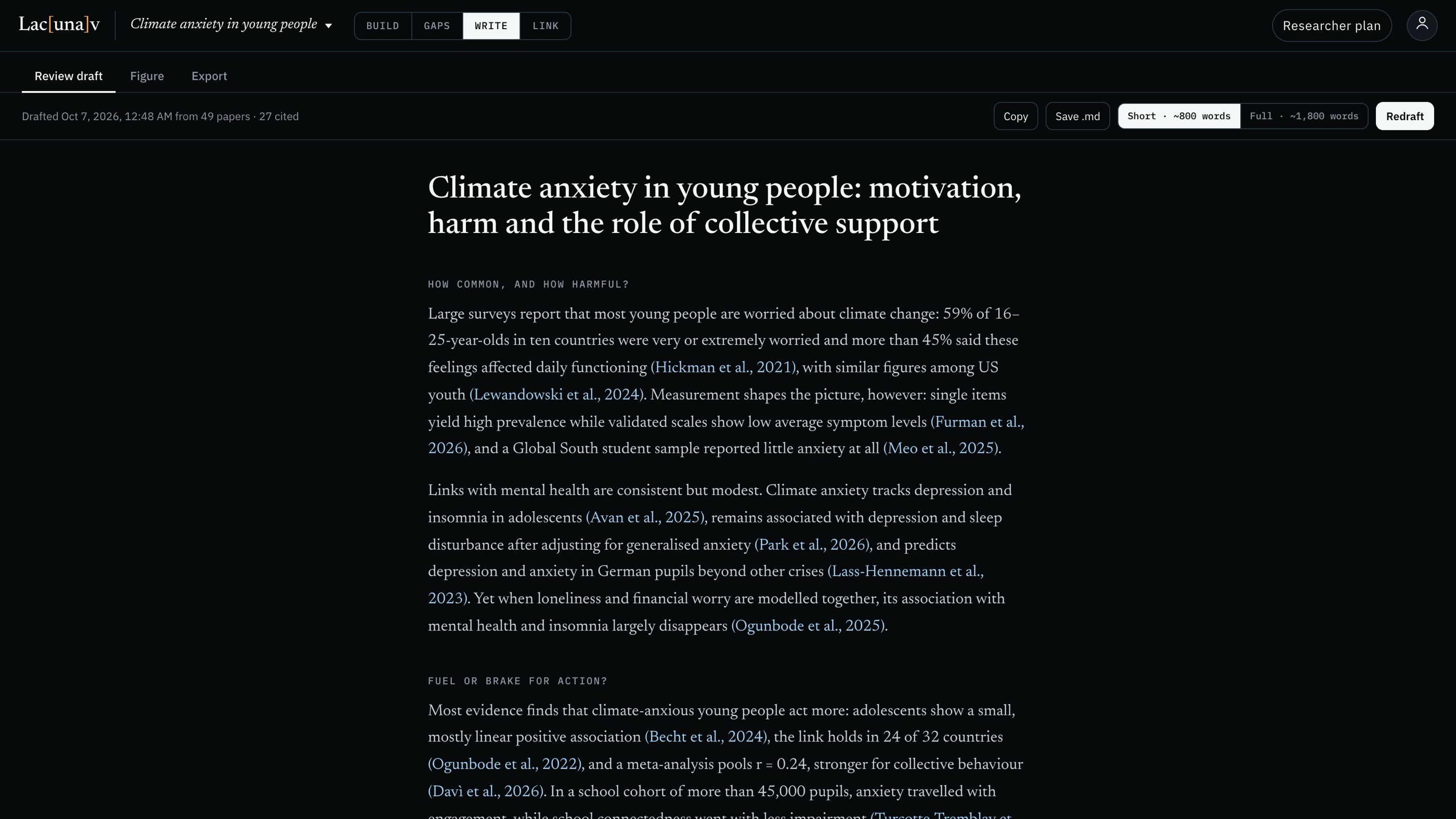
Climate anxiety in young people: motivation, harm and the role of collective support: How common, and how harmful? · Fuel or brake for action? · What collective support can do in schools. Every citation is a paper on the map.
Link
Two maps: Climate anxiety in young people × Heat and adolescent mental health
The main map studies anxiety about a threat many young people mostly read about; the second map studies harm from heat and disasters they live through. They meet where exposure becomes worry: severe-weather exposure already goes with more climate distress and more plans to act, yet neither literature follows the same adolescents from heatwave to climate anxiety.
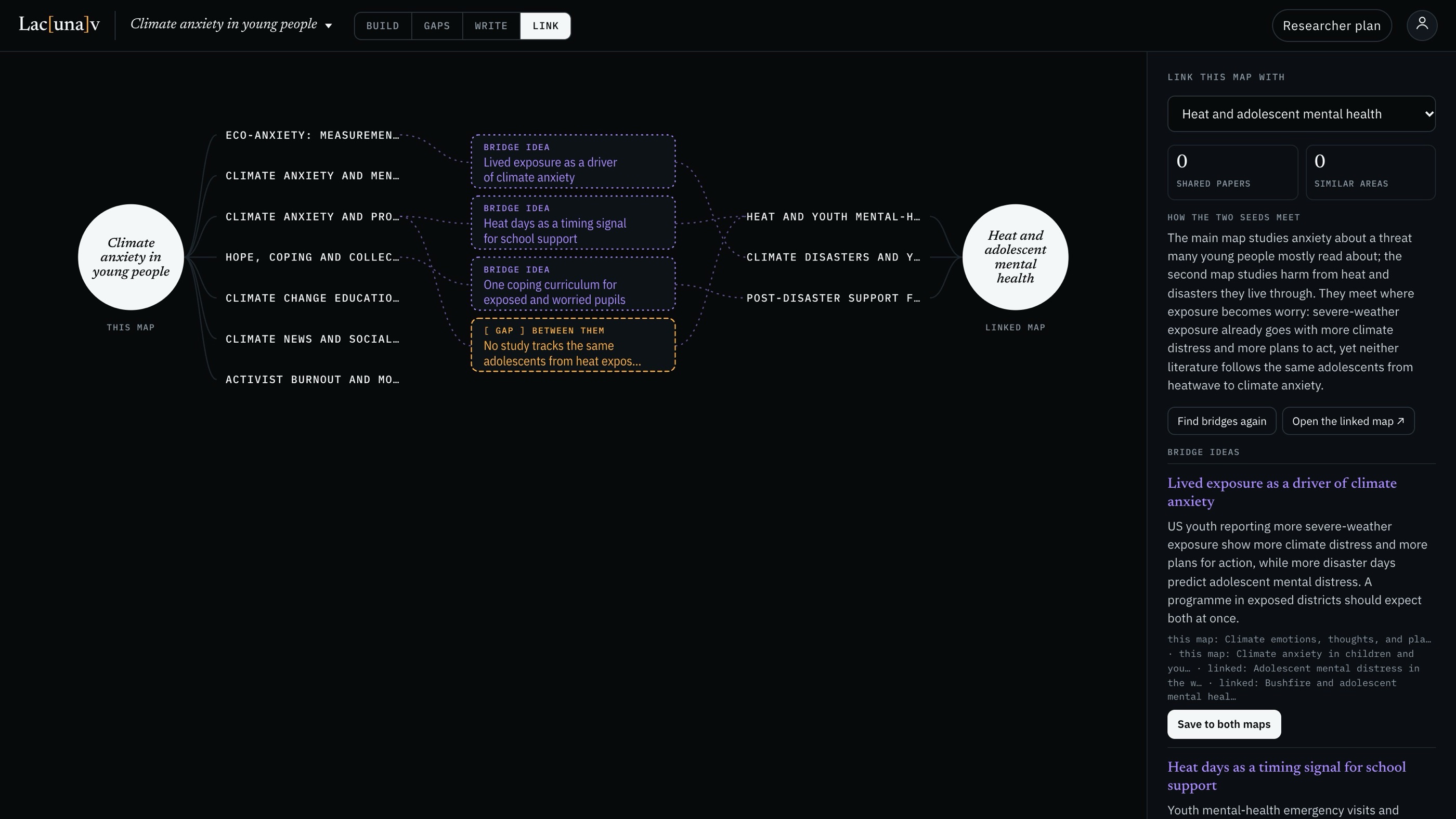
Lived exposure as a driver of climate anxiety
US youth reporting more severe-weather exposure show more climate distress and more plans for action, while more disaster days predict adolescent mental distress. A programme in exposed districts should expect both at once.
Heat days as a timing signal for school support
Youth mental-health emergency visits and suicidality presentations rise on hot days. School climate programmes could time emotional-support sessions to the heat season and lean on school connectedness, which went with less climate-anxiety impairment.
One coping curriculum for exposed and worried pupils
Avoidant and ruminative coping go with more post-disaster stress; meaning-focused coping turns climate distress into action. The same coping skills could serve pupils who live through disasters and those who worry about them.
No study tracks the same adolescents from heat exposure to climate anxiety
Heat studies count emergency visits without asking about climate anxiety; climate-anxiety surveys rely on self-reported exposure. Linking measured heat exposure to climate anxiety in one adolescent cohort is open.
Key papers
The sources behind the findings
A selection of the 49 real papers on the map: the ones read in depth and the ones each finding rests on.
- Climate Anxiety in Perspective: A Look at Dominant Stressors in Youth Mental Health and Sleep
C. Ogunbode et al. · 2025 · Annals of the New York Academy of Sciences · doi:10.1111/nyas.70057 - Feeling anxious and being engaged in a warming world: climate anxiety and adolescents' pro-environmental behavior.
Andrik I. Becht et al. · 2024 · Journal of child psychology and psychiatry, and allied disciplines · doi:10.1111/jcpp.14035 - The relationship between climate change anxiety and pro-environmental behavior in adolescents: the mediating role of future self-continuity and the moderating role of green self-efficacy
Ziqi Qin et al. · 2024 · BMC Psychology · doi:10.1186/s40359-024-01746-1 - Adolescents’ impairment due to climate anxiety is associated with self-efficacy and behavioral engagement: a cross-sectional analysis in Quebec (Canada)
Anne-Marie Turcotte-Tremblay et al. · 2024 · BMC Public Health · doi:10.1186/s12889-024-20333-y - A randomized controlled trial of the effect of a nature-based intervention on climate capability and eco-anxiety in teenagers
Róise Glynn et al. · 2025 · Frontiers in Psychology · doi:10.3389/fpsyg.2025.1648880 - Burnout and Belonging: How the Costs and Benefits of Youth Activism Affect Youth Health and Wellbeing
J. Conner et al. · 2023 · Youth · doi:10.3390/youth3010009 - Evaluating the Effectiveness of a Creative Arts and Philosophical Inquiry Intervention Rooted in Self-Determination Theory to Promote Adaptive Coping with Eco-Anxiety among Elementary School Children: A Pilot Randomized Cluster Trial
T. Léger-Goodes et al. · 2026 · Chronic Stress · doi:10.1177/24705470261442334 - Evaluating the Public Climate School, a multi-component school-based program to promote climate awareness and action in students: A cluster-controlled pilot study
Jan Keller et al. · 2023 · The Journal of Climate Change and Health · doi:10.1016/j.joclim.2023.100286 - Climate change hopefulness, anxiety, and behavioral intentions among adolescents: randomized controlled trial of a brief “selfie” video intervention
L. Benoit et al. · 2025 · Child and Adolescent Psychiatry and Mental Health · doi:10.1186/s13034-025-00872-x - Climate anxiety in children and young people and their beliefs about government responses to climate change: a global survey.
Caroline Hickman et al. · 2021 · The Lancet. Planetary health · doi:10.1016/s2542-5196(21)00278-3 - Psychological and Emotional Responses to Climate Change among Young People Worldwide: Differences Associated with Gender, Age, and Country
S. Clayton et al. · 2023 · Sustainability · doi:10.3390/su15043540 - The psychological cost of climate change: anxiety among adolescents and young adults - a cross-sectional study
S. Meo et al. · 2025 · Frontiers in Psychiatry · doi:10.3389/fpsyt.2025.1422338 - Climate anxiety in children and young people: A systematic review of prevalence and measurement methods
L. Furman et al. · 2026 · The Journal of Climate Change and Health · doi:10.1016/j.joclim.2026.100705 - Climate anxiety, wellbeing and pro-environmental action: Correlates of negative emotional responses to climate change in 32 countries
C. Ogunbode et al. · 2022 · Journal of Environmental Psychology · doi:10.1016/j.jenvp.2022.101887
What to trust, and what to check
Strong leads, not verdicts
Real sources
Every paper is a real Consensus record with its link and DOI. Nothing was invented to fill a gap.
AI reading, your judgement
Skims and deep reads use abstracts, not full texts. “Open” means the check found no close study: a lead to verify.
How this case was made
The map was built from eleven Consensus searches. The team is an illustrative role, not a real group; their programme is hypothetical.
Your turn
What’s [missing] in your field?
Write one sentence about your argument and let the map grow from there.