Lacuna navigation for researchers
Navigate to what’s [missing].
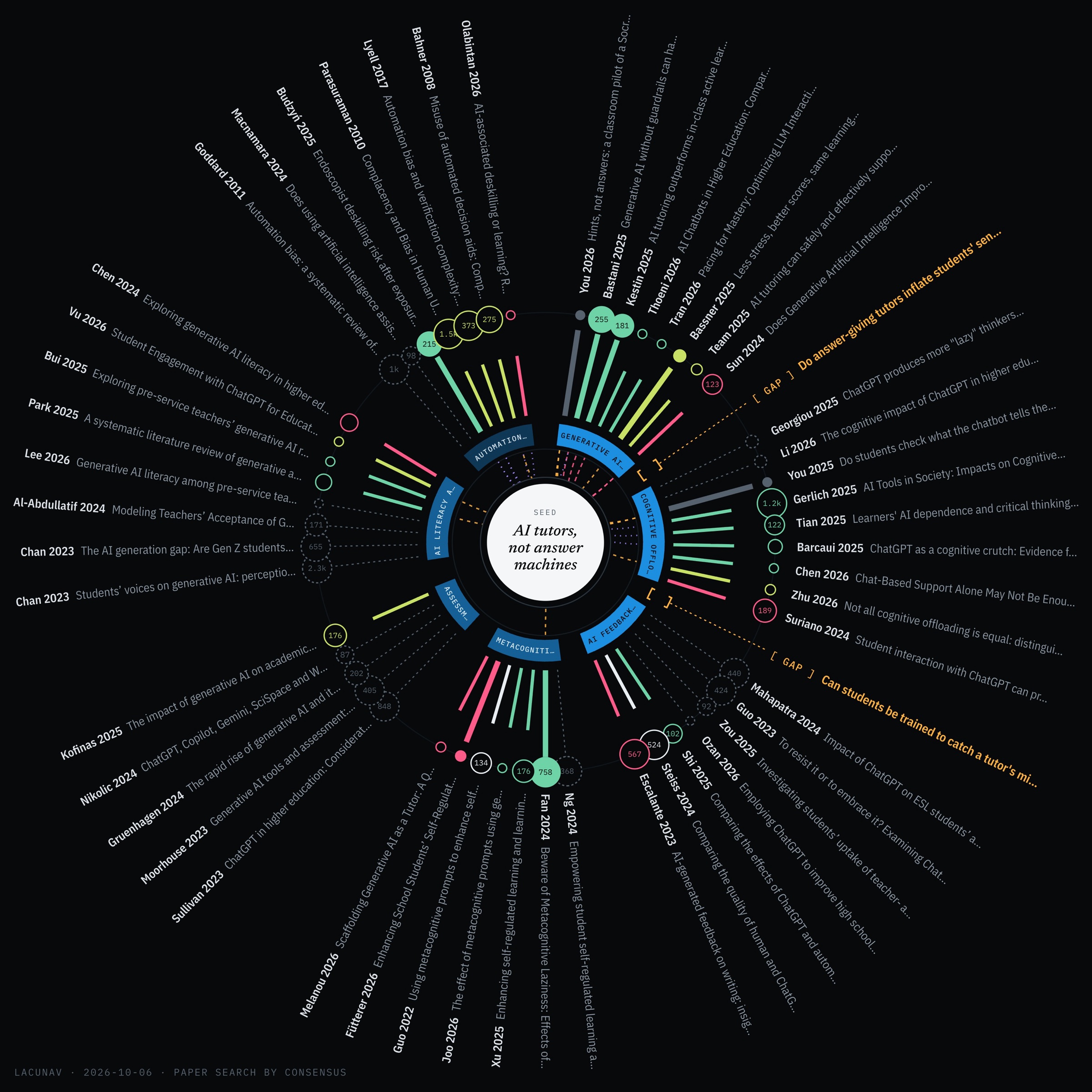
Your next paper is hiding in the gaps between fields. Start from one sentence about your idea. Lacunav maps the literature around it with real papers, reads them in stages, and shows you where the field agrees, contradicts itself and goes silent. Then it checks every gap against the literature.
Invite-only beta · free plan included · paper search powered by Consensus
- Real, linked papers
- Every gap checked
- Your work as anchor
- Bridges between fields
- BibTeX · RIS · Zotero
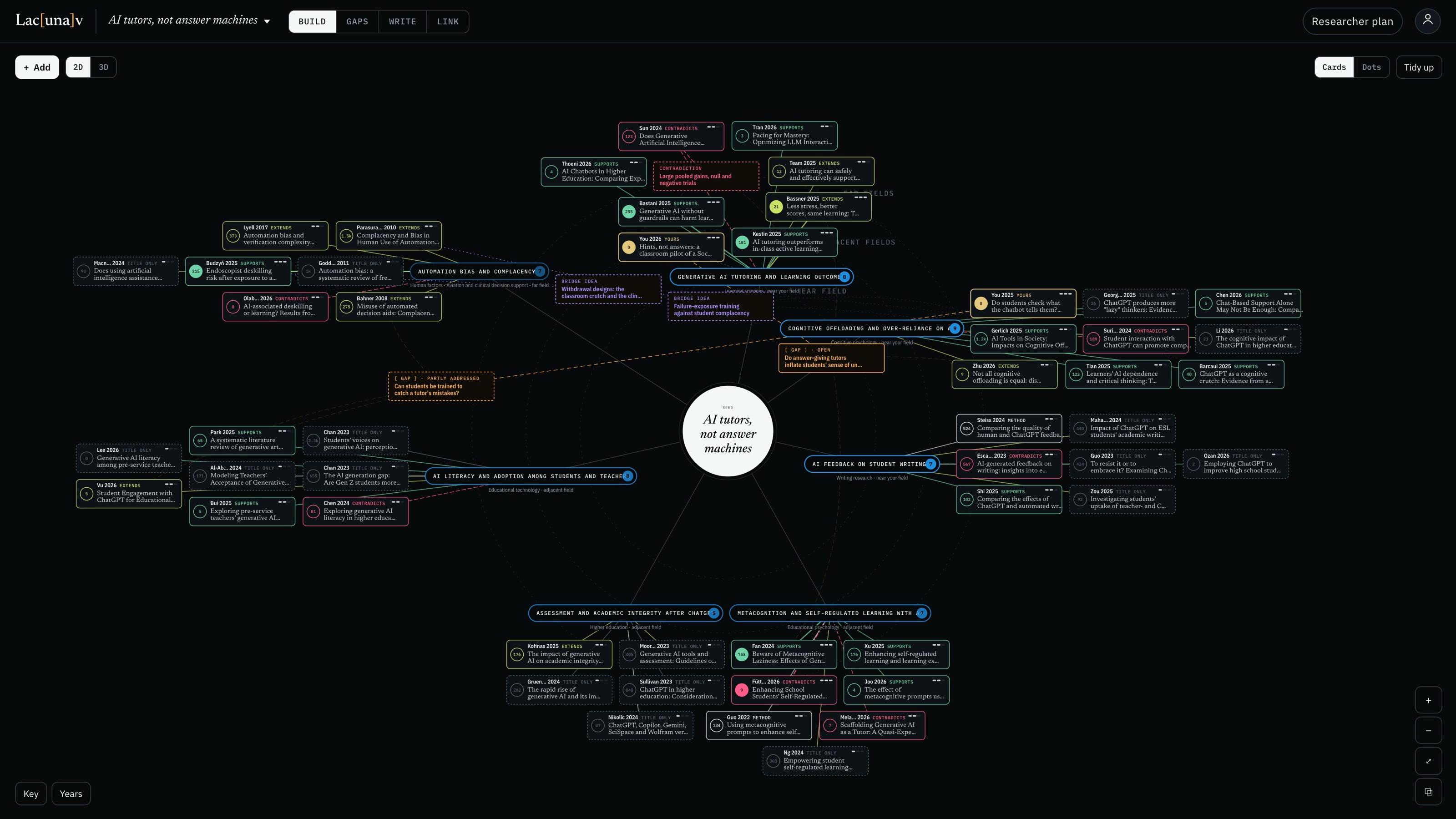
The same map, in Build mode
Every paper on a card. Every card where it stands.
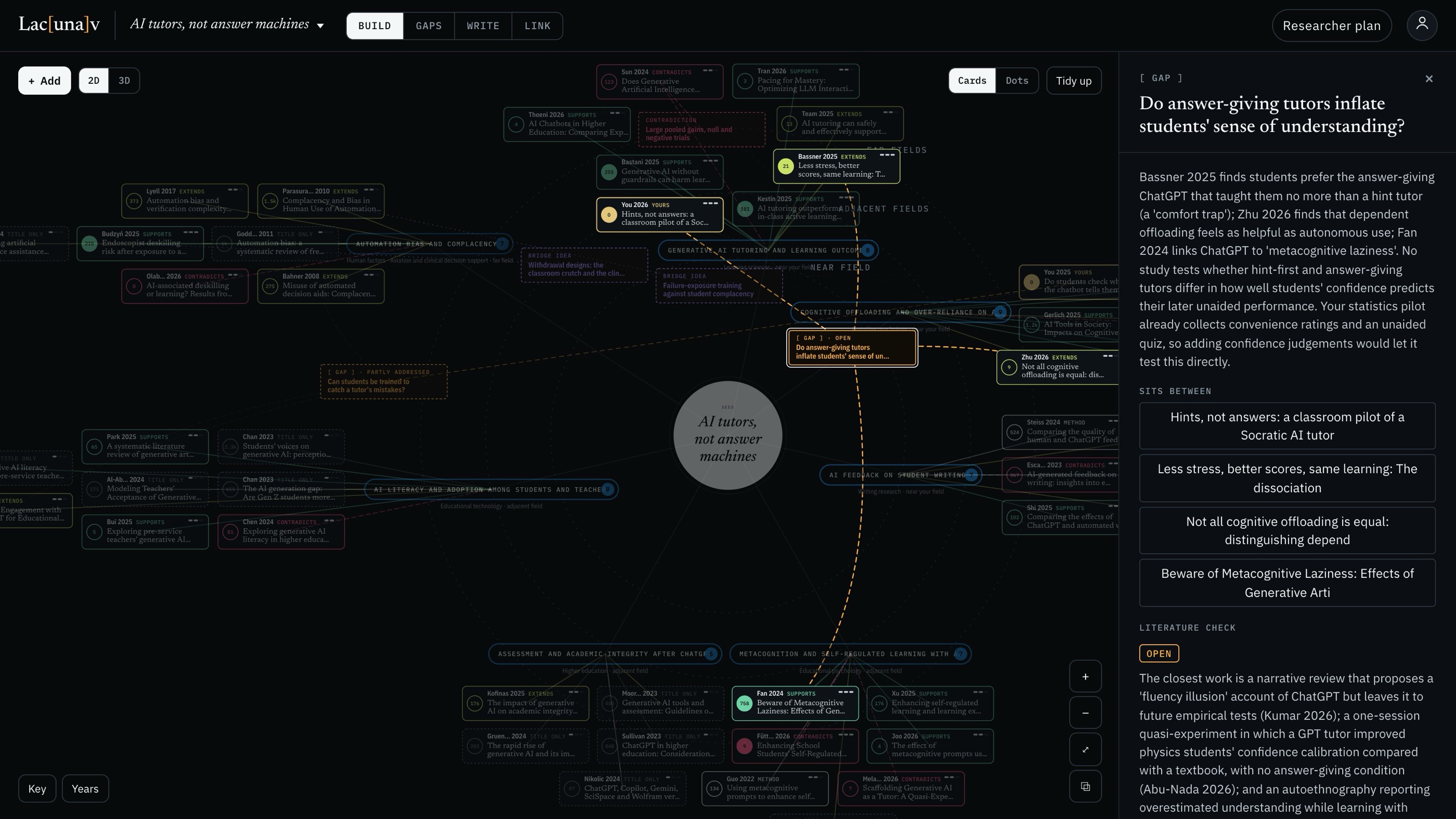
Seven research areas around one sentence, from AI-tutoring trials to automation bias in aviation and medicine. Cards are coloured by stance on the thesis; gold ones are the researcher’s own work; amber boxes are gaps.
The shift
Search shows what is known. A map shows what is [missing].
Type a keyword and a database gives you the centre of a field. Original work comes from the edges, where two or three fields overlap and nobody has looked yet. Keyword search doesn’t look there. Lacunav maps those overlaps.
How it works
From one sentence to a map of the literature
Write your idea
One sentence about what you are arguing. Add your own publications by DOI, BibTeX, RIS or Zotero.
See the neighbourhood
The seed fans out into near, adjacent and deliberately far fields, each with a reason it belongs.
Read in stages
Real papers from Consensus. A title card first, then a quick skim of each, and a deep read of the ones that matter.
Find what’s missing
Empty cells, contradictions and bridges between fields. Each gap can be checked with a fresh literature search.
Four modes
The app is organised by what you are trying to do
Build: grow the map
A constellation of your fields. Every paper card shows its author, year and where it stands on your thesis.
- Paper cards coloured by stance: supports, contradicts, extends, method, tangential
- Your own papers in gold, read against everything else
- Drag a branch, tidy the layout, or switch to a 3D view of the whole field
- Add an area, a paper by DOI, a Zotero collection or a BibTeX/RIS file
Gaps: test your thesis
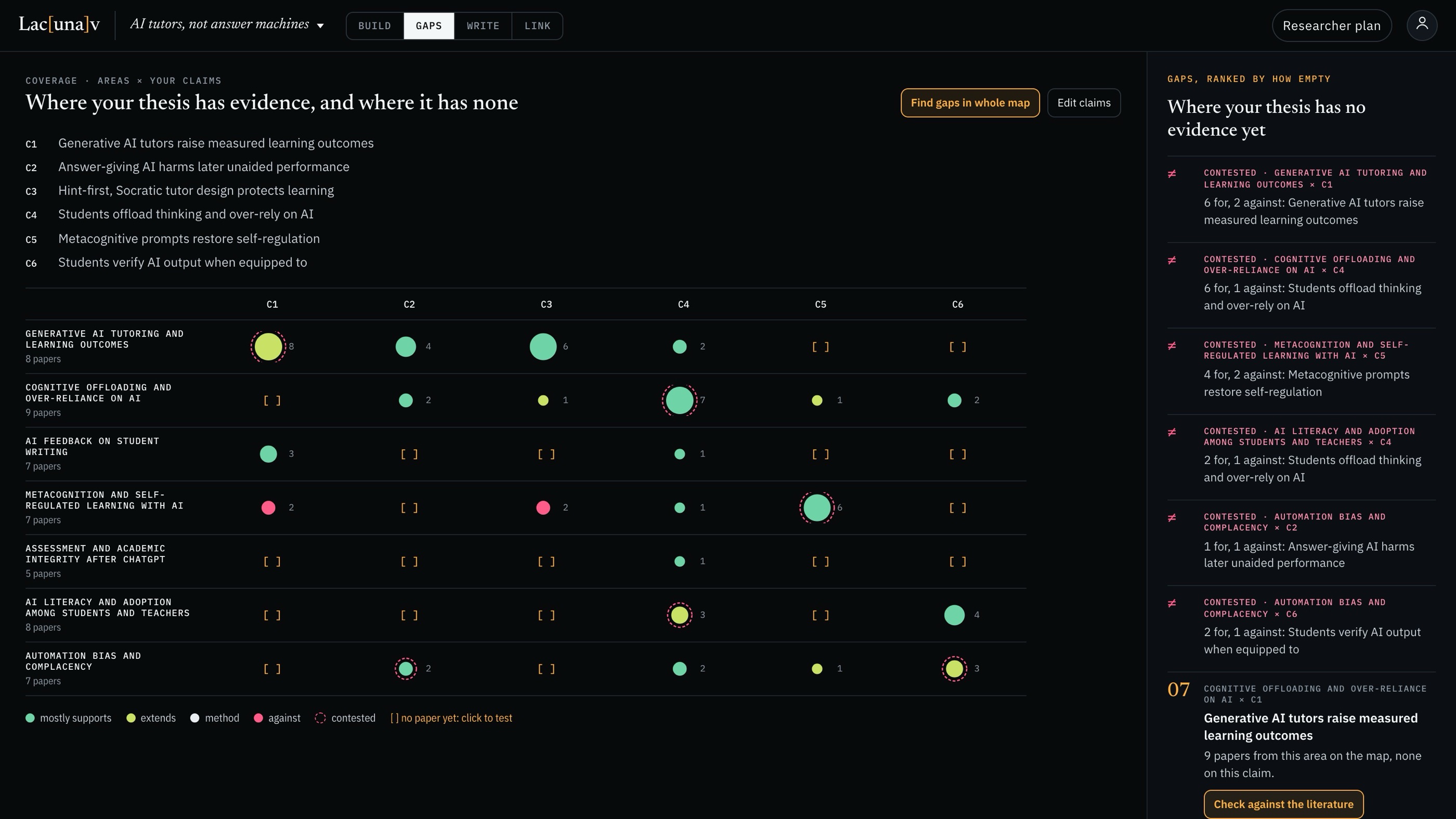
Your thesis is split into claims and set against every area. Empty cells are where nobody has looked.
- An areas × claims grid; each [ ] is an untested combination
- Gaps ranked by how empty they are
- Contested cells flagged where papers disagree
- “Check against the literature” runs a fresh search and gives a verdict
Write: turn the map into text
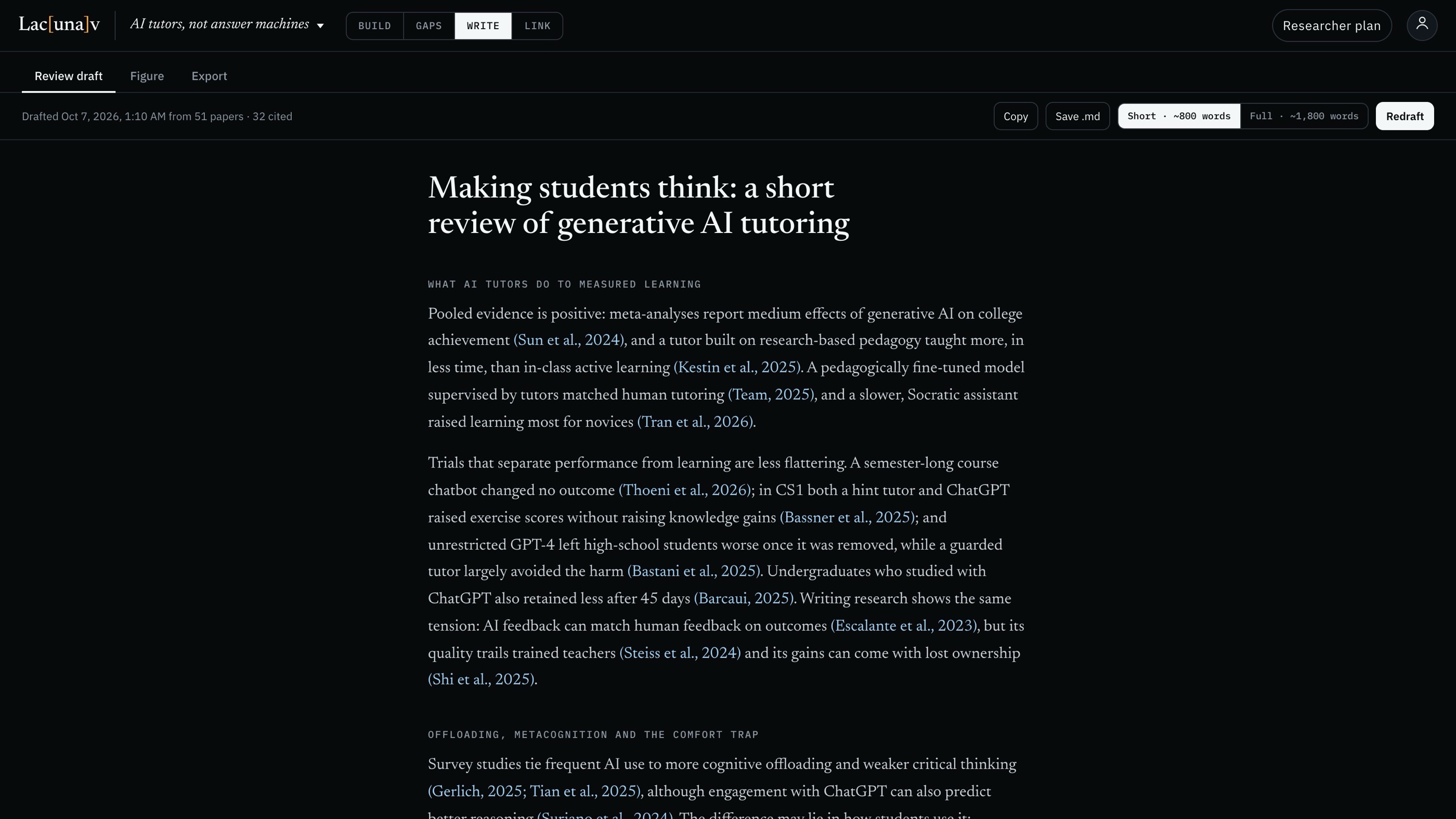
A cited review drafted from the papers on your map, a figure of the whole field, and clean exports.
- Short (~800 words) or full (~1,800 words) review drafts, author–year citations
- Orbit: a radial figure of the map, downloadable as SVG
- Export Markdown, BibTeX and RIS, or send to a Zotero collection
Link: connect two maps
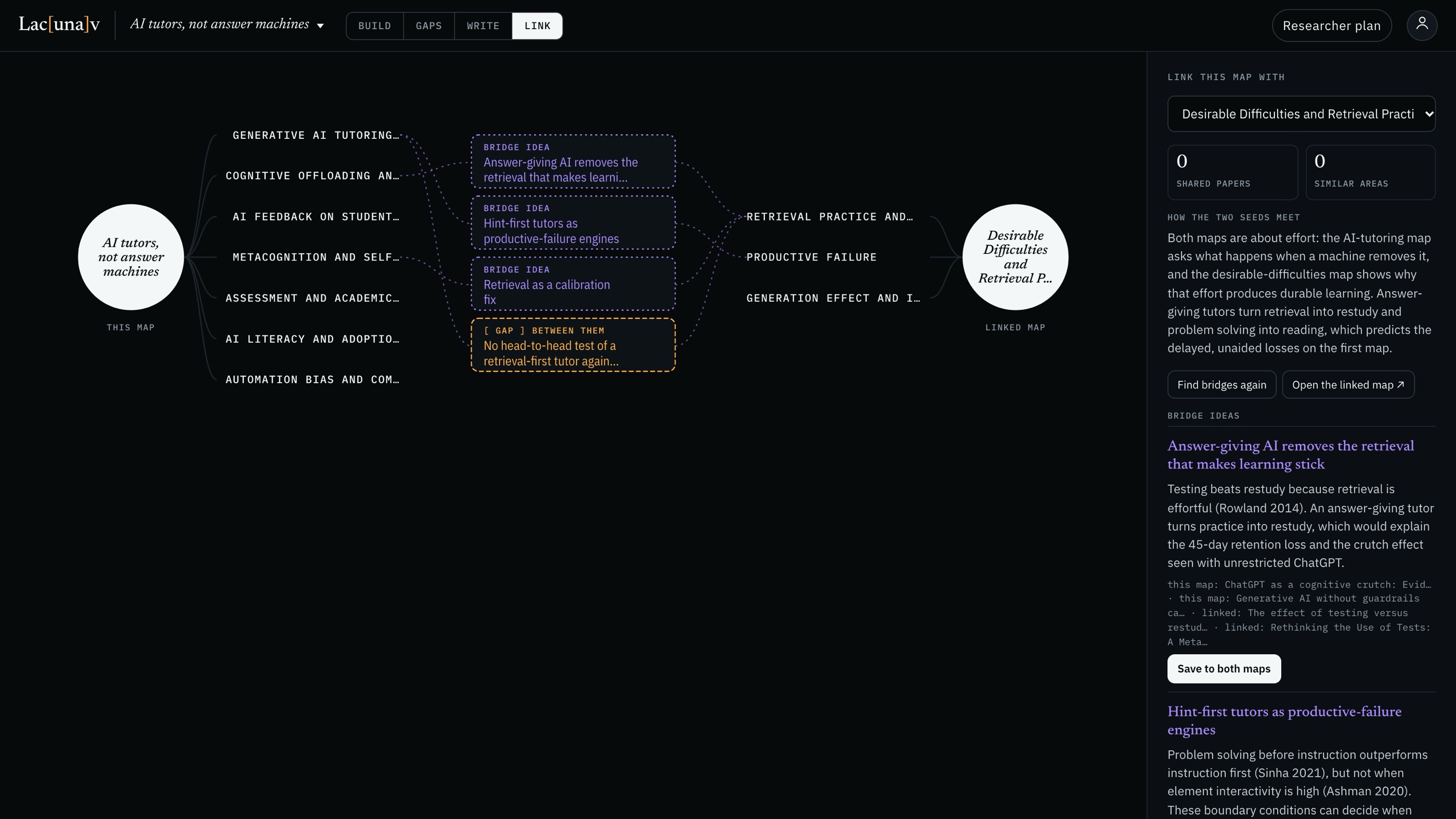
Put two of your research lines side by side. Lacunav finds the shared papers, bridge ideas and the gap between them.
- Shared papers and similar areas, counted
- Bridge ideas, each with a search query you can run again
- Save an idea into both maps at once
Featured case study · Education
Do AI tutors teach, or just [answer]?
A doctoral researcher has a pilot study on a hint-giving AI tutor. Meta-analyses say generative AI raises learning; some trials say students do worse once it’s taken away. Lacunav read 49 papers against their pilot and found the question it could answer.
Do answer-giving tutors inflate students’ sense of understanding?
Students prefer the tutor that hands them answers, and dependent use feels as helpful as independent use. No study tests whether tutor design changes how well students’ confidence predicts their later, unaided performance.
Three case studies
Three fields, three gaps worth a paper
AI tutors, not answer machines
Do AI tutors teach, or just answer? 51 papers, and an open gap next to the researcher’s own pilot.
Read →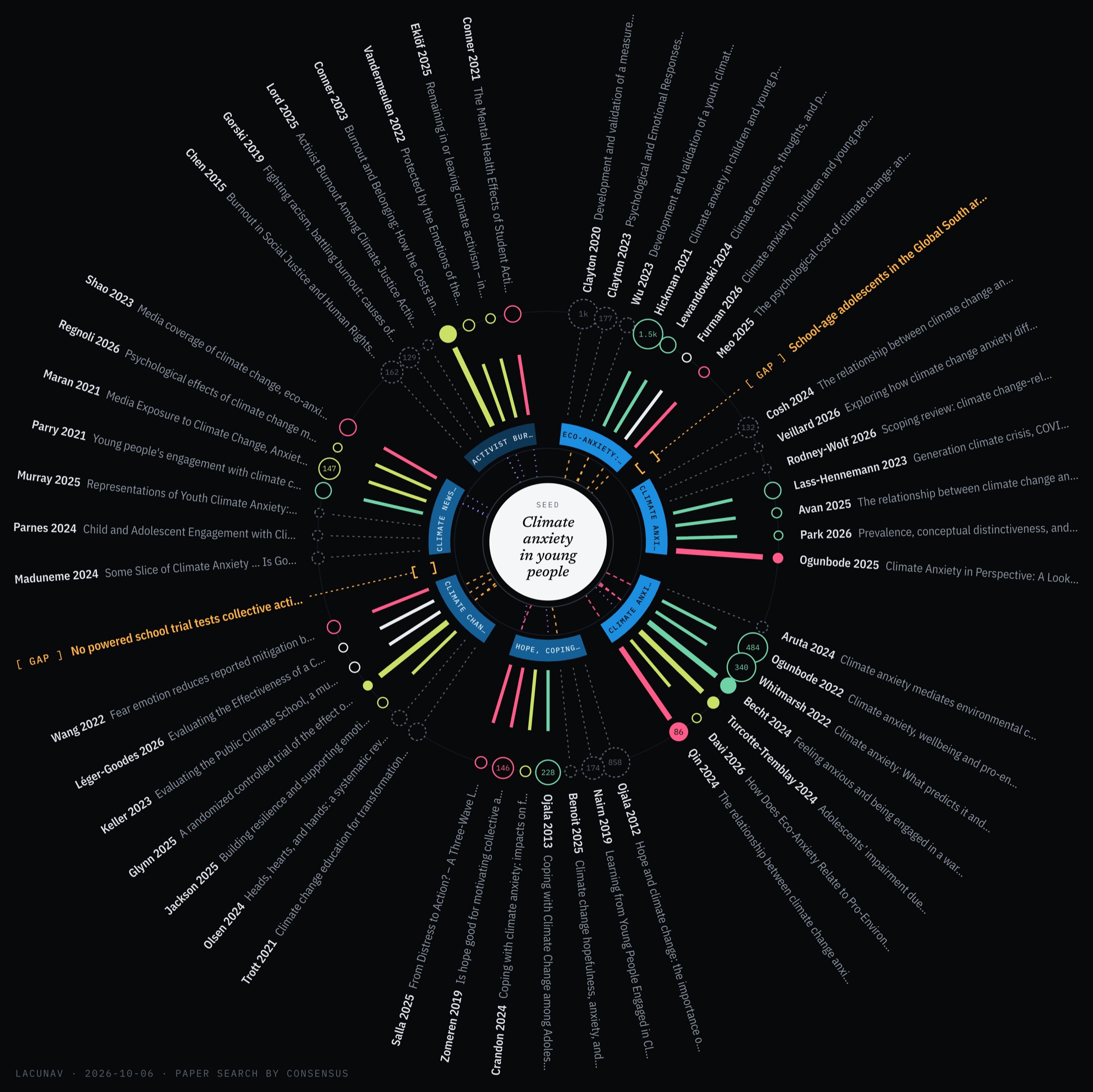
Climate anxiety in young people
Does worry fuel action or stall it? 49 papers, and the school trial nobody has run.
Read →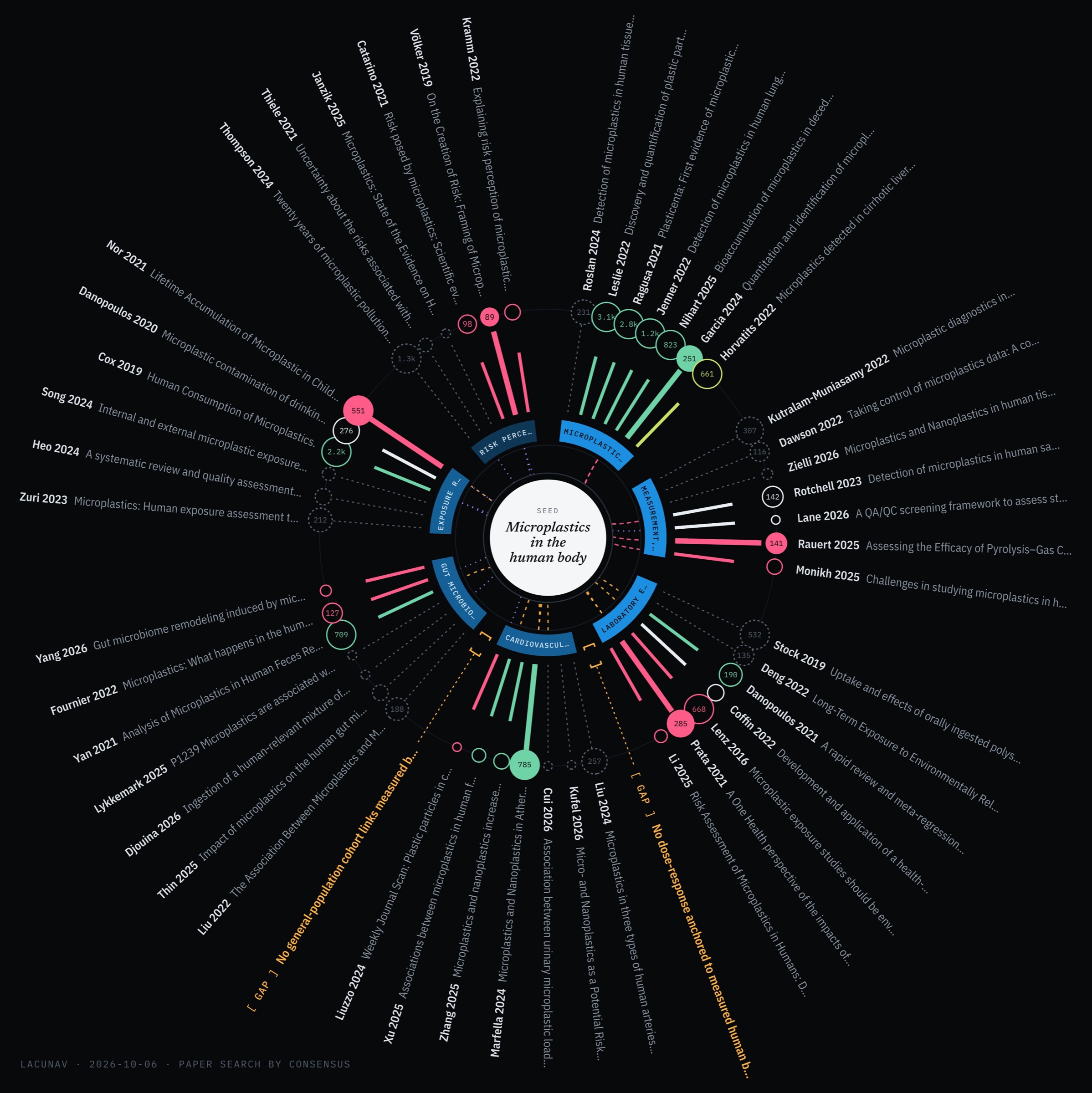
Microplastics in the human body
Detected everywhere, demonstrated nowhere? 47 papers, and the cohort study nobody has done.
Read →Why it’s different
Not another search box, and not a chatbot’s guess
Real papers, every time
Every paper on the map is a real record from Consensus, which indexes over 200 million research papers. Each comes with its link and DOI. Nothing is invented to fill a space.
Gaps are checked, not guessed
An AI can always propose a “gap”. Lacunav runs a fresh search on it, shows you the closest existing studies and marks it open, partly addressed or addressed.
Read against your work
Your own publications sit on the map in gold. Every skim, deep read and gap check is written against them, so you can see what you have already argued and what would be new.
Who it’s for
One tool across the research cycle
Find a thesis question
Map a field you are new to and see where the open questions are before you commit.
ResearchersYour next article
Find the paper nobody has written yet, between the fields you already know.
Grant writersProve it’s new
A state of the art with sources, and a gap check to show the question is open.
SupervisorsStart students well
Begin a student’s thesis with a map of their field, then keep it as a shared reference.
Plans
Start free. Pay for the reading you use.
Everything you ask of Lacunav costs research credits. A full map is about 50. The free plan gives you 30 a month plus 50 welcome credits, enough for your first map.
$0
30 credits a month, 50 welcome credits, 2 saved maps.
$12
400 credits a month (about 8 maps), with a university email.
$24
600 credits a month, about 12 maps. Unlimited saved maps.
$59
1,600 credits a month for heavy reading weeks and whole reviews.
Lacunav · /la·KOO·nav/
A lacuna is a gap: the missing passage in a manuscript, the question no one has asked yet. Lacunav is a lacuna navigator.